Why bridging the gap between military and COTS systems is key to seamless defence comms (Studio)
Technology that enables armed forces to leverage existing network infrastructure can be a game-changer in many combat scenarios.


Brought to you in partnership with Bittium
Military communications today face a challenging and fragmented landscape. Seamless “interworking” between different networks is difficult, while the configuration of hybrid solutions can be highly complex.
Against this backdrop, the ability to utilise both military and civilian infrastructure is vital. Plugging in commercial-off-the-shelf (COTS) networks offers significant advantages, providing armed forces with the ability to maintain and extend communications, deliver effective command and control and attain comprehensive situational awareness.
This connectivity is especially crucial for multi-domain operations (MDO), and Bittium’s new FUSOR (Flexible Unifying Software Router) product enables militaries to meet the communications demands of the modern battlespace by extending their mobile ad-hoc networks (MANETs) into COTS infrastructure.
“Tactical networks and public infrastructure must come together to support tactical needs and joint operations,” said Matias Ruokamo, product manager for FUSOR at Finland-based Bittium. “Technology needs to support the operational needs of unified networks.”
Achieving flexible networking
The new FUSOR is designed to meet these demands. Purpose-built for military users, it integrates with existing IT and tactical infrastructure, including Bittium’s Tactical Wireless IP Network (TAC WIN), Tough SDR tactical radios, and the Tough Comnode VoIP/IP communications device.
This integration enables wider networking across domains, providing the flexibility to easily extend MANET routing from edge to core. Militaries can join tactical MANETs while utilising commercial servers or devices such as laptops. The same network routing can be used on both COTS and Bittium’s military platforms, while operations require no configuration or integration by the user.
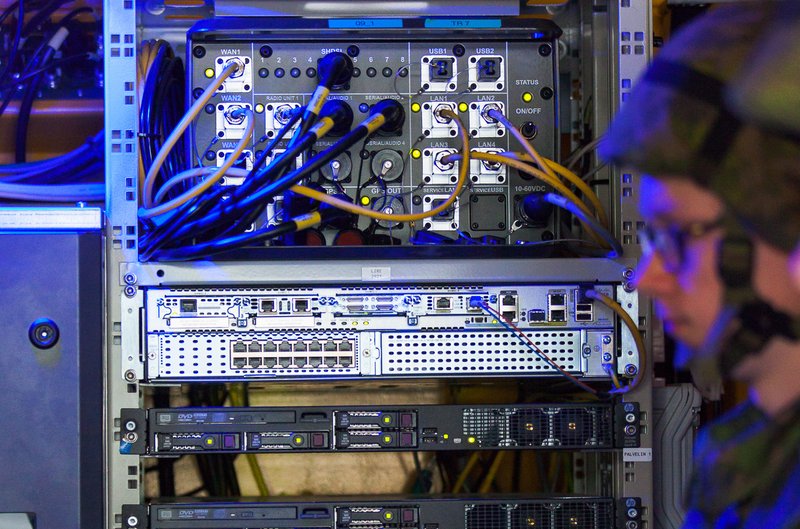
Military demand for such adaptability drove the development of the router, said Ruokamo.
“Customers and integrators needed a product that could extend our networking solution into COTS technology,” he explained. “The FUSOR gives a range of options to expand and combine networks, providing the flexibility military operators need.”
Foregrounding ease of operation
In a tactical environment, commercial and military networks bring both their own advantages and challenges, making hybrid networking increasingly important.
Military routers and infrastructure are ruggedised and certified according to the latest defence standards. COTS infrastructure, on the other hand, while it does not fully meet these stringent requirements, is readily available and can be leveraged to create a streamlined solution.
“There are clear advantages to utilising both COTS and military platforms,” Ruokamo said.
He outlined a range of use cases for the FUSOR. For example, the technology could be used to combine multiple MANETs to support wider networking, or see personnel utilising public 5G with network slicing alongside their military-spec tactical radio capability.
In this hybrid scenario, the router will connect the networks to deliver the strongest possible connectivity at any given moment.
“The user doesn’t even need to know which network is being used – connections are handled by the software router working in conjunction with our other tactical networking products,” Ruokamo said. “Crucially, this takes place without any need for user action.”
Maximising interoperability
The FUSOR was designed with real military needs in mind. Bittium works closely with the Finnish Defence Forces (FDF), Ruokamo said, meaning the company has been able to validate and integrate the product in close cooperation with experienced users: “We do testing ourselves, but thanks to our cooperation with the FDF, we also get fast feedback from them.”
Bittium utilises a system-level development model, he said, meaning that new products – including the router – are already interoperable with existing ones. “It’s an integrated product from the outset,” Ruokamo explained. “There are no lags when introducing a new product to the wider system.”
He explained that a traditional interoperability challenge occurs when communications systems are built using separate technologies for different requirements: "This often requires extensive integration work, with, for example, situational awareness data initially failing to transition between different network layers."
"Solving this kind of problem and reducing the operator's integration workload is a fundamental aspect of Bittium's design approach to interoperability," Ruokamo continued. "To enable communication between the tactical edge and tactical core, our various product families have been developed to operate seamlessly together within the same network."
Evolving the battlespace
As demonstrated by the war in Ukraine and conflicts in the Middle East, the MDO battlespace is constantly evolving. Militaries must continuously adapt to the latest developments in drone warfare, autonomy and beyond.
Because the FUSOR is a software product, it can rapidly update as needed based on emerging threats or on feedback from customers, noted Ruokamo. The system will benefit from the regular system-level software updates Bittium provides across its product suite, he added.
“We deliver updates all the time to many different layers of the product, including operating systems, interface protocols and security solutions,” Ruokamo explained. “The nature of the product means we can rapidly add new features and other capabilities.”
The FUSOR will become a more independent system in the coming years, expanding its use cases for a variety of environments. While it will continue to extend the capabilities of Bittium’s wider product line, it will not be as firmly coupled with its current tactical radios or networking products as it is today, Ruokamo explained.
“We think the best solution for software-defined networks is to enable seamless networking across military and COTS networks, with easy planning and without any need for user action to deliver operations,” he said. “That's the future for connectivity in the battlespace.”
Find out more about how Bittium can deliver seamless tactical communications.

You may also like

More from Studio
-
![Layered protection: How air defence is adapting to rising drone and missile threats (podcast)]()
Layered protection: How air defence is adapting to rising drone and missile threats (podcast)
A surge in aerial threats – from advanced missiles to low-cost drones – is reshaping the way militaries approach air defence, driving demand for flexible, multi-layered solutions.
-
![Light Reconnaissance Strike – enabling a vital mission set (Studio)]()
Light Reconnaissance Strike – enabling a vital mission set (Studio)
A new system-of-systems concept will unlock digital integration of sensors and weapons for Light Forces, allowing them to shape the battlefield environment on their own terms and upgrade legacy platforms.
-
![Energy evolution: How laser defence systems are powering the next phase of air defence (podcast)]()
Energy evolution: How laser defence systems are powering the next phase of air defence (podcast)
Laser-based air defence is moving from promise to deployment as global threats evolve. In this special podcast, we explore how high-energy laser systems are reshaping interception strategies.
-
![Unlocking the potential of Light Forces in modern warfare (Studio)]()
Unlocking the potential of Light Forces in modern warfare (Studio)
The Ukraine conflict has highlighted the strategic importance of “Light Forces” – rapidly deployable dispersed units, able to conduct an expanding range of mission sets. What technologies and equipment are needed to ensure their success in combat?
-
![Resilience, adaptiveness and collaboration vital for success in space (Studio)]()
Resilience, adaptiveness and collaboration vital for success in space (Studio)
Speakers at the Defence In Space Conference (DISC) 2025 highlighted the critical and evolving role of space in national security, defence and the global economy.
-
![Precision on Demand: The New Age of Loitering Weapons (Podcast)]()
Precision on Demand: The New Age of Loitering Weapons (Podcast)
Loitering munitions provide vital capabilities in the disrupted and unpredictable modern battlespace, from real-time ISR to a virtually “on demand” strike capability. Rafael is looking to the future of the technology, empowering systems to operate with increasing autonomy in hostile environments.