Jaguar prowls into action
The Jaguar UGV is in use to patrol the Israel-Gaza border. (Photo: IDF)
The newest robotic ground vehicle for the IDF is designed for integration with tactical forces in mobile, dismounted operations.


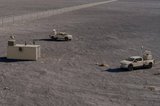
The IDF has confirmed for the first time that it is using the Jaguar heavy unmanned ground vehicle (UGV) along the Israel-Gaza border.
After an operational evaluation, the IDF plans to equip the UGV with additional sensors and weapon systems ‘according to the mission’, a spokesperson told Shephard.
Jaguar is currently armed with a General Robotics Pitbull RWS with a machine gun controlled from a remote operation command post. The UGV can also be armed with either the FN MAG or Israeli Negev machine gun.
The CONOPS for Jaguar is to integrate it with tactical forces in mobile, dismounted operations. The IDF
Our news & analysis is now part of Defence Insight®
A Basic-level or higher Defence Insight subscription is now required to view this content.




More from Land Warfare
-
![Front-line support: how UK industry is helping tackle Ukraine’s landmine challenges]()
Front-line support: how UK industry is helping tackle Ukraine’s landmine challenges
Pearson Engineering has provided equipment and engineering expertise to the Armed Forces of Ukraine since the beginning of the full-scale Russian invasion in 2022. The British company is now working to deepen engagement with the Ukrainian defence industry, expanding its support for the country’s population and laying the foundations for future technological innovation.
-
![AUSA 2026: companies adapt munitions and missiles for greater effect at lower costs]()
AUSA 2026: companies adapt munitions and missiles for greater effect at lower costs
Rather than developing entirely new weapons, defence companies are looking to build on existing weapons and systems to deliver greater capability, control costs and accelerate fielding.
-
![With changing patterns in Middle Eastern procurement, is Europe missing out?]()
With changing patterns in Middle Eastern procurement, is Europe missing out?
Traditional suppliers are struggling to meet the Middle East’s armoured vehicle modernisation needs, creating opportunities for South Korean manufacturers and regional defence industries.
-
![AUSA 2026: CUAS market expands as suppliers target new threats and operational requirements]()
AUSA 2026: CUAS market expands as suppliers target new threats and operational requirements
New developments from MARSS, MyDefence, Mountain Horse Solutions and Rafael suggest that future counter-drone protection will increasingly depend on combining advanced detection, rapid interception and integrated defensive networks.