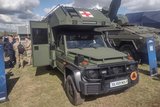
Is motorisation set to be the next evolution of towed artillery?
The MKE Uran, unveiled at SAHA 2026, is intended to provide a mobile fires platform. (Photo: author)


Artillery remains a key tool on the modern battlefield. Artillery platforms, however, are increasingly at risk from enemy fire, whether from other artillery or uncrewed aerial systems (UAS). Consequently, there is a need for ever more mobile platforms, capable of performing shoot-and-scoot operations.
This poses a particular danger to towed platforms. Lacking a means of self-propulsion, they risk being detected and destroyed within seconds of opening fire. Given that towed platforms still account for the majority of artillery worldwide, the question then becomes how they can remain effective in the years ahead.
In Ukraine, one solution has been the use
Our news & analysis is now part of Defence Insight®
A Basic-level or higher Defence Insight subscription is now required to view this content.




More from Land Warfare
-
![British Army's open plan draws diverse offerings for Land Rover replacement]()
British Army's open plan draws diverse offerings for Land Rover replacement
The UK Ministry of Defence has avoided being prescriptive in its search to replace the British Army’s Land Rover, meaning vehicle types being offered range from Land Rover Defender Wolf II and Humvee to the hybrid series Fering Pioneer. What does this mean for the procurement process?
-
![DVD 2026: British Army’s Ajax back in the hands of users as part of a gradual return]()
DVD 2026: British Army’s Ajax back in the hands of users as part of a gradual return
The introduction of Ajax vehicles into British Army service was stopped after operator health issues were reported during an exercise, but manufacturer General Dynamics Land Systems UK believes work over the past 10 months has dealt with the problems.
-
![Polaris expands Arctic mobility offering as US military orders grow]()
Polaris expands Arctic mobility offering as US military orders grow
The Military 850 Voyageur 155 Crossover has secured orders from the US Army, Air Force and Marine Corps, addressing demand for agile Arctic mobility with passenger, cargo and towing capacity.
-
![More bidders move onto starting grid for British Army Land Rover replacement programme]()
More bidders move onto starting grid for British Army Land Rover replacement programme
The Light Mobility Vehicle segment of the UK’s Land Mobility Programme for the British Army may actually be about to make progress, or at least likely bidders seem to think so. Shephard spoke with several contenders who revealed their views on how the army should replace the ageing fleet.