Lockheed Martin receives MLRS follow-on order


Lockheed Martin has received a $353.2 million US Army follow-on contract for the seventh production lot of Guided Multiple Launch Rocket System (GMLRS) Unitary rockets, it has been announced.
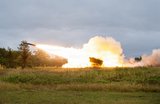
Designed for destroying targets at ranges up to 70 km, GMLRS is an all-weather, rapidly deployable, long-range rocket that delivers precision strike beyond the range of most conventional weapons.
According to Lockheed Martin, GMLRS Unitary rockets have achieved a combat-reliability rate of 98% and have established a ‘reputation for affordability’.
Rockets from this production lot will be supplied to the US Army and US Marine Corps, and to the armies of Italy, Jordan and Singapore, with the contract representing Italy’s first purchase of GMLRS rockets. Deliveries are scheduled to begin in December 2013.
‘GMLRS continues to be the long-range precision-fire weapon of choice when commanders need to decisively and accurately attack high value targets while minimizing the risk of collateral damage,’ Lt Col TJ Wright, the US Army’s product manager for precision guided missiles and rockets, said in a 19 July statement.
‘This contract award will result in the delivery of a critical capability to our warfighters who rely on GMLRS to deliver all-weather, 24/7 responsive fires when they need it most.’
US and allied forces have already fired more than 2,200 of the precision munitions in support of military operations.
Each GMLRS rocket is packaged in an MLRS launch pod and is fired from the Lockheed Martin HIMARS or M270 family of launchers. The longer-range GMLRS+ rocket, with a reach of more than 120km, is being developed and tested by Lockheed Martin using company funds.



More from Land Warfare
-
![With changing patterns in Middle Eastern procurement, is Europe missing out?]()
With changing patterns in Middle Eastern procurement, is Europe missing out?
Traditional suppliers are struggling to meet the Middle East’s armoured vehicle modernisation needs, creating opportunities for South Korean manufacturers and regional defence industries.
-
![AUSA 2026: CUAS market expands as suppliers target new threats and operational requirements]()
AUSA 2026: CUAS market expands as suppliers target new threats and operational requirements
New developments from MARSS, MyDefence, Mountain Horse Solutions and Rafael suggest that future counter-drone protection will increasingly depend on combining advanced detection, rapid interception and integrated defensive networks.
-
![Integrated approach: transforming vehicle communications for a new era of warfare]()
Integrated approach: transforming vehicle communications for a new era of warfare
In the modern battlespace, military intercom systems can no longer operate in isolation. They must instead be integrated with the wider tactical network, gaining operational advantages through secure communications with dismounted soliders and other assets across domains.
-
![AUSA 2026: Nammo advances 155mm ramjet artillery technology for extended-range fire]()
AUSA 2026: Nammo advances 155mm ramjet artillery technology for extended-range fire
Nammo is developing new artillery ammunition designed to extend firing ranges, combining ramjet propulsion research with conventional, base-bleed and rocket-assisted projectile designs.