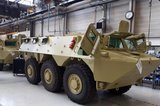
Full windshield AI tactical display developed for Patria 6x6 vehicles
The system has been designed to utilise sensor fusion for operations in low-visibility battlefield environments such as darkness and smoke. (Photo: Distance Technology Oy and Patria)
The new system is designed to turn windshields into real-time tactical data screens which would remove the need for XR glasses and provide battlespace awareness for situational readiness in low-visibility environments.


Patria, the company’s eAlliance programme and Distance Technologies, a Finnish developer of glasses-free eXtended Reality (XR), have developed a new system which turns windshields into real-time 3D and artificial intelligence (AI) tactical data screens.
Initially designed for use with Patria 6x6 vehicles the Distance display will mean personnel within vehicles will no longer need to wear individual night-vision or infrared goggles to see in dark or obscured environments. The technology could be transferred across different vehicle types.
The companies said the initial design parameters for the collaboration “were to utilise advanced sensor fusion for use in low-visibility battlefield environments such as
Our news & analysis is now part of Defence Insight®
A Basic-level or higher Defence Insight subscription is now required to view this content.


More from Land Warfare
-
![AUSA 2026: companies adapt munitions and missiles for greater effect at lower costs]()
AUSA 2026: companies adapt munitions and missiles for greater effect at lower costs
Rather than developing entirely new weapons, defence companies are looking to build on existing weapons and systems to deliver greater capability, control costs and accelerate fielding.
-
![AUSA 2026: CUAS market expands as suppliers target new threats and operational requirements]()
AUSA 2026: CUAS market expands as suppliers target new threats and operational requirements
New developments from MARSS, MyDefence, Mountain Horse Solutions and Rafael suggest that future counter-drone protection will increasingly depend on combining advanced detection, rapid interception and integrated defensive networks.
-
![US Army seeks CAML-Lite autonomous launcher prototypes for 2027 live-fire trials]()
US Army seeks CAML-Lite autonomous launcher prototypes for 2027 live-fire trials
The optionally crewed, C-130-transportable platforms would combine modular offensive and defensive fires with autonomous resupply, with demonstrations planned for Talisman Sabre 2027.