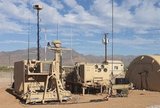
Force Protection announces sale of two Ocelot vehicles to UK MoD
Force Protection, Inc., a leading designer, developer and manufacturer of survivability solutions and provider of total life cycle support for those products, today announced that Force Protection Europe, a wholly owned subsidiary of Force Protection Industries, Inc., received a contract from the United Kingdom Ministry of Defence (MoD) for the purchase of two Ocelot vehicles for further testing in respect of the Light Protected Patrol Vehicle (LPPV) program.
Ocelot has been designed by Force Protection Europe and Ricardo, plc, a UK based automotive engineering company.
David Hind, Managing Director of Force Protection Europe, said: “We are very pleased with how our own testing and development schedule has been progressing. Ocelot has been performing well in tests since the middle of last year and has demonstrated that it offers unprecedented levels of survivability and maneuverability for a vehicle of this size and weight.”
Graeme Rumbol, Global Vehicle Product Group Director for Ricardo plc, added: “The MoD has already completed a number of their own tests on two of our vehicles so we’re delighted that they are now investing in these vehicles so that they can carry out further trials. Ocelot is building upon our existing long-standing relationship with the UK MoD which has most recently seen Ricardo carrying out extensive fleet upgrades to create the new RWMIK Plus standard of WMIK vehicle.”
Source: Force Protection



More from Land Warfare
-
![Europe commits to long-range fires but countries move in different directions]()
Europe commits to long-range fires but countries move in different directions
Sweden, Croatia and France are pursuing different rocket artillery solutions as European armies seek greater reach, survivability and industrial resilience.
-
![Polaris expands Arctic mobility offering as US military orders grow]()
Polaris expands Arctic mobility offering as US military orders grow
The Military 850 Voyageur 155 Crossover has secured orders from the US Army, Air Force and Marine Corps, addressing demand for agile Arctic mobility with passenger, cargo and towing capacity.
-
![Northrop Grumman pushing ahead with smaller Integrated Battle Command System]()
Northrop Grumman pushing ahead with smaller Integrated Battle Command System
Northrop Grumman’s Integrated Battle Command System is in service with Polish forces and is being introduced to US forces, with further development underway on the original platform as well as a smaller, more mobile system.