Danish MoD awards $23.5 million helmet contract


The Danish Defence Acquisition and Logistics Organisation (DALO) has awarded Galvion a $23.5 million contract to procure helmets for the national armed forces.
The company announced the seven-year agreement on 30 July. Under the deal, Galvion will deliver helmets and spare parts from Q4 2020.
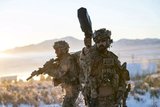
The manufacturer will hand over the Batlskin Caiman Special Forces helmet system and the newly launched PDxT helmet, which introduces a new geometry to balance space, comfort and impact performance together with a low-profile shell.
Both models can be configured to meet a variety of impact standards and mission requirements.
This is the second time DALO has chosen Galvion as a supplier. In 2012, the business (under its former corporate name Revision Military) won a contract to deliver helmets and spare parts to Denmark.
Galvion’s protective head systems and soldier power management systems also equip defence forces from the US, Canada, UK, Germany, the Netherlands, Norway, Poland, UAE, Israel, Australia, New Zealand and Indonesia.

You may also like
More from Land Warfare
-
![Predicted air defence spending boom opens doors to Indian industry]()
Predicted air defence spending boom opens doors to Indian industry
Recent conflicts have created a surge in interceptor demand worldwide while exposing potential supply chain challenges, positioning India as a cost-effective partner and scalable supplier.
-
![March land forces roundup: A new war confronts the old drone problem]()
March land forces roundup: A new war confronts the old drone problem
The attack by the US and Israel on Iran which began at the end of February presented a Ukraine-like scenario of drone-led warfare – in fact the same drone type in the Shahed – and the problem of how to counter them.
-
![The overlooked ally: Canadian support for Ukraine surpasses some European partners]()
The overlooked ally: Canadian support for Ukraine surpasses some European partners
Since Russia’s full-scale invasion of Ukraine in 2022, Canada has committed more military assistance than France in terms of GDP.
-
![France mulls new turret options to increase its VBCI IFV’s firepower]()
France mulls new turret options to increase its VBCI IFV’s firepower
The proposed enhancements could better position the French Army’s armoured infantry fighting vehicle for future export campaigns.
-
![US Army moves towards calls for bids for medium UGV as competitors warm up]()
US Army moves towards calls for bids for medium UGV as competitors warm up
The US Army’s Medium Modular Equipment Transport Trailer (M-METT) programme is planned to provide a platform between Increment II of Small Multipurpose Equipment Transport and the Palletized Load System.