US conducts latest South China Sea sail-by amid trade talks


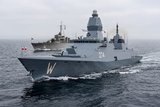
A US Navy guided-missile destroyer on Monday sailed near disputed islands in the South China Sea where Beijing has built military installations, sparking anger in China as trade talks between the two countries kicked off.
The US and its allies periodically send planes and warships through the area, which is claimed by China, to signal to Beijing their right under international law to pass through the waters.
The USS McCampbell sailed within 22 kilometres of the Paracel Islands ‘to challenge excessive maritime claims,’ US Pacific Fleet spokeswoman Rachel McMarr told AFP.
She added that so-called ‘freedom of navigation’ operations are ‘not about any one country, nor are they about making political statements.’
Beijing confirmed the sail-by, calling it a violation of China’s sovereignty which has damaged ‘peace, safety and order’ in the South China Sea.
Aircraft and warships were scrambled, sending out warnings for the American vessel to leave the area, known as Xisha in Chinese.
‘We urge the US to immediately stop such provocative actions,’ Chinese foreign ministry spokesman Lu Kang told a regular press briefing, adding that Beijing had lodged a diplomatic complaint with Washington.
‘China will continue to take the necessary measures to defend national sovereignty and security.’
The operation came as Chinese and US officials kicked off talks in Beijing to find a solution to a bitter trade war that prompted the two sides to impose tariffs last year on more than $300 billion in total two-way trade.
‘All operations... demonstrate that the United States will fly, sail and operate wherever international law allows. That is true in the South China Sea as in other places around the globe,’ McMarr said.
The Paracel Islands are claimed by China, Taiwan and Vietnam.
Beijing asserts nearly all of the South China Sea as its territory, while Taiwan, the Philippines, Brunei, Malaysia and Vietnam all claim parts.



More from Naval Warfare
-
![Canada assesses security equipment changes for Polar Icebreaker Imnaryuaq]()
Canada assesses security equipment changes for Polar Icebreaker Imnaryuaq
The Canadian Department of National Defence is evaluating communications and reconnaissance changes for CCGS Imnaryuaq’s expanded maritime security role, while retaining its 2032 acceptance target.
-
![All eyes on Royal Navy’s Type 93 market engagement as industry prepares bids]()
All eyes on Royal Navy’s Type 93 market engagement as industry prepares bids
Responses are due by 29 October as the Royal Navy tests the market, with BAE Systems’ Herne and MSubs’ Excalibur setting up a contest where payloads may decide the winner.
-
![US Navy’s MQ-25 Stingray approaches carrier-integration tests]()
US Navy’s MQ-25 Stingray approaches carrier-integration tests
Boeing has outlined its upcoming precision-landing and carrier-airspace trials as MQ-25 manufacturing shifts towards Illinois, with initial Lot 1 deliveries expected in 2029.
-
![From Poland to the Pacific: can Miecznik become a blueprint for other navies?]()
From Poland to the Pacific: can Miecznik become a blueprint for other navies?
Babcock is taking its Polish industrial partnership approach to Denmark and New Zealand as navies seek sovereign shipbuilding skills alongside ships.