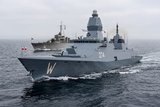
Type 26 progresses with BAE contract


BAE Systems has been awarded a £472 million 15-month contract by the UK Ministry of Defence (MoD) to progress the Type 26 Global Combat Ship programme, the company announced on 22 March.
The UK plans to buy eight of the advanced anti-submarine warfare ships.
Effective from April 2016, the contract extends the current demonstration phase to mature the detailed design of the vessels and manufacture key equipment for the first three ships.
BAE Systems is working with Babcock for the ships’ air weapons handling systems, GE Power Conversion for the electric propulsion motor and drive systems and Rolls-Royce for the gas turbines. The company expects to award manufacturing contracts to around 50 companies under this phase of the programme.
Geoff Searle, Type 26 programme director, BAE Systems, said: ‘This is a significant investment in the programme and an endorsement of the government’s commitment to sustain this important national capability. The Type 26 programme is progressing well and over the coming months more of our partners in the supply chain will start to manufacture equipment for the first three ships as we continue to progress towards the manufacturing phase.’
Eventually, the Type 26 ships are planned to replace the Type 23 frigates.


More from Naval Warfare
-
![Canada assesses security equipment changes for Polar Icebreaker Imnaryuaq]()
Canada assesses security equipment changes for Polar Icebreaker Imnaryuaq
The Canadian Department of National Defence is evaluating communications and reconnaissance changes for CCGS Imnaryuaq’s expanded maritime security role, while retaining its 2032 acceptance target.
-
![US Navy’s MQ-25 Stingray approaches carrier-integration tests]()
US Navy’s MQ-25 Stingray approaches carrier-integration tests
Boeing has outlined its upcoming precision-landing and carrier-airspace trials as MQ-25 manufacturing shifts towards Illinois, with initial Lot 1 deliveries expected in 2029.
-
![From Poland to the Pacific: can Miecznik become a blueprint for other navies?]()
From Poland to the Pacific: can Miecznik become a blueprint for other navies?
Babcock is taking its Polish industrial partnership approach to Denmark and New Zealand as navies seek sovereign shipbuilding skills alongside ships.
-
![Unsettled waters in the North: can navies still trust their Arctic acoustic maps?]()
Unsettled waters in the North: can navies still trust their Arctic acoustic maps?
The changing Arctic environment is creating new challenges for submarine detection, driving demand for distributed sensors, uncrewed underwater vehicles and real-time acoustic modelling.