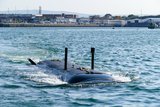
SeaSpider ATT completes trials in Baltic Sea


Atlas Elektronik’s SeaSpider anti-torpedo-torpedo (ATT) has successfully completed sea trials in cooperation with the German Bundeswehr technical center for ships and naval weapons, maritime technology and research (WTD 71), the company announced on 2 April.
The Baltic Sea trials for torpedo defence studies were conducted on a WTD 71 multipurpose vessel. The trials included the full functional chain with torpedo detection, classification and localisation (TDCL) sonar, and the third generation SeaSpider prototype with its above water launcher.
During trials both an Mk37 torpedo-derived AUV and DM2A3 torpedoes served as threats which were detected and localised with passive and active TDCL. The attendant data was used to cue the SeaSpider launch. SeaSpider acquired the threats and homed in into closest point of approach (CPA). Successful intercept equivalent CPA was verified by acoustic and optical means.
With these trials, the full sensor-to-shooter functional chain of a hardkill surface ship torpedo defence system with TDCL and the SeaSpider ATT has been successfully demonstrated on a surface ship.


More from Naval Warfare
-
![Five years on: where could opportunities emerge next for AUKUS Pillar II?]()
Five years on: where could opportunities emerge next for AUKUS Pillar II?
Payload commonality, combat systems and electronic warfare are emerging as likely priorities as the trilateral partnership balances building submarines with sharing industrial ecosystems.
-
![Singapore expands maritime presence with future-ready Sentinel OPV]()
Singapore expands maritime presence with future-ready Sentinel OPV
Singapore is building space for uncrewed systems and future technologies into its new Sentinel-class OPVs, reflecting a wider move towards adaptable vessels capable of maintaining persistent maritime presence.
-
![From the Baltic to the Gulf: where USV procurement is heading next]()
From the Baltic to the Gulf: where USV procurement is heading next
Saildrone’s new Copenhagen base is one sign of a larger shift, as navies globally turn to uncrewed vessels for surveillance and mine clearance.
-
![Israeli Navy looks to expand as war reshapes future force requirements]()
Israeli Navy looks to expand as war reshapes future force requirements
Israel’s navy is preparing for a larger and more technically diverse role, but its ambitions could be impacted by supply chain restrictions, accelerating demand for domestic naval production as well as autonomous maritime capabilities.
-
![Quantum sensing gathers pace as navies eye undersea advantage]()
Quantum sensing gathers pace as navies eye undersea advantage
As AI dominates defence conversations, industry increasingly points to quantum sensing as the technology set to change submarine and uncrewed underwater vehicle operations.