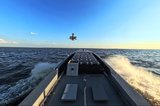
Royal Australian Navy test-fires Raytheon Standard Missile-2
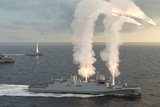
The Royal Australian Navy fired Raytheon Company’s Standard Missile-2 Block IIIA anti-air warfare missile during recent tests on board the HMAS Melbourne.
“With this firing, Melbourne’s crew validated the work done to transition warships from SM-1 capability to SM-2,” said Ron Shields, Raytheon’s SM-2 program director. “This was the first time an SM-2 has been launched by any navy from an upgraded frigate, clearing the way for other fleets to make similar upgrades.”
As the most widely fielded variant of SM-2, Block IIIA is deployed by the US and eight allied navies. The missile is part of a long-range area air defense capability capitalizing on communication techniques, midcourse guidance, advanced signal processing and propulsion improvements. These enhancements substantially increase the intercept range to 90 nautical miles (104 statute miles) and provide high- and low-altitude intercept capability and performance against advanced anti-ship missile threats.
Three other Royal Australian Navy frigates are scheduled to be upgraded to the SM-2 configuration. The modifications, along with upgrades to the combat management systems, launchers and other systems, will improve the ships’ capabilities against low-altitude and supersonic targets and provide extended area air defense protection.
“Standard Missile has been the US Navy’s primary surface-to-air fleet air defense weapon for more than three decades,” said Shields. “This test shows the flexibility of SM-2, and why it is the global air defense missile of choice.”
Source: Raytheon



You may also like

More from Naval Warfare
-
![How could Rheinmetall’s GMF 140 fit with ongoing programmes in North America?]()
How could Rheinmetall’s GMF 140 fit with ongoing programmes in North America?
With Canada committed to its River-class replacement and the USN pursuing a lower-cost frigate, Rheinmetall will need to demonstrate where the GMF 140 can fill a capability gap in the North American fleet.
-
![Australian industry programme builds pipeline for Virginia-class sustainment]()
Australian industry programme builds pipeline for Virginia-class sustainment
Australian businesses can now bid to support Virginia-class submarine sustainment in Western Australia, as momentum around the Henderson Defence Precinct also builds.
-
![South Korea, Japan and Turkey vie for US shipbuilding access in future frigate contest]()
South Korea, Japan and Turkey vie for US shipbuilding access in future frigate contest
Washington’s search for a foreign-built frigate could hand South Korea, Japan and Turkey a larger prize than a double-hull order: a foothold inside the US shipbuilding industrial base.
-
![Japan’s FY2027 budget bets on stand-off systems to offset demographic decline]()
Japan’s FY2027 budget bets on stand-off systems to offset demographic decline
Japan’s FY2027 defence budget backs stand-off strike, a 17-aircraft MQ-9B buy and a declared bid to lead the world in uncrewed maritime assets, alongside new frigates, submarines and support ships.
-
![Russia’s uncrewed boat portfolio hints at future naval demand]()
Russia’s uncrewed boat portfolio hints at future naval demand
Ukrainian intelligence has catalogued more than 20 Russian uncrewed surface vessels, revealing a portfolio weighted towards mine warfare and logistics, with implications for Western naval investment.
-
![Ukraine’s new long-range 12m autonomous vessel can deploy other drones]()
Ukraine’s new long-range 12m autonomous vessel can deploy other drones
Ukraine’s UForce unveiled the MV11 uncrewed surface vessel, designed to launch and support other naval drones at sea, fuelling debate over the future of autonomous maritime task groups.