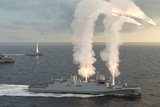
Double success for MBDA’s Sea Ceptor system


Two guided firings of the Sea Ceptor air defence system have been successfully carried out by MBDA, demonstrating the functionality of the system’s Command and Control (C2) system. The firings were conducted on 29 May and 5 June at the land-based Vidsel range facilities in Sweden.
This was the first seeker guided firings for the Common Anti-air Modular Missile (CAMM), including using its two-way data link to communicate with the Sea Ceptor system, with the C2 system demonstrating its ability to process data from a third party radar and then command an engagement by a CAMM missile.
According to MBDA, the CAMMs performed as expected, with their active Radio Frequency (RF) seeker acquiring the targets shortly after launch and staying in track until they intercepted their respective targets.
CAMM is under development for the Royal Navy and Royal New Zealand Navy in the Sea Ceptor system and the British Army with the Future Local Area Air Defence System (FLAADS) Land system.
Sea Ceptor secured its first export order with the signing of a contract on 21st May 2014 for the Royal New Zealand Navy. FLAADS Land entered its Assessment Phase with the signing of a contract with the UK Ministry of Defence on 22nd January 2014.
Dave Armstrong, group director for short and medium range missiles, MBDA, said: ‘The success of these two firings is a major step forward for the Sea Ceptor programme and the CAMM missile, and directly benefits the associated FLAADS Land equivalent. It is also instrumental in proving that the UK MoD’s Portfolio Management Agreement with MBDA can develop complex weapons through the use of commonality and modularity, and do so in an affordable manner.’
The Portfolio Management Agreement (PMA) between the UK MOD and MBDA provides a contractual framework for the long-term acquisition of the UK’s Complex Weapon military capability, which aims to improve flexibility and reduce cost.
These latest firings build on a previous campaign of successful CAMM instrumented firings completed in April 2013, as well as extensive seeker data gathering trials.



More from Naval Warfare
-
![Suppliers await next step in Australia’s mine warfare transition]()
Suppliers await next step in Australia’s mine warfare transition
Australia’s mine countermeasure capability remains in flux as the Huon-class nears retirement, but accelerated investment in autonomous systems is opening a path for industry.
-
![Can the US Navy ask Indo-Pacific allies to do more while training with them less?]()
Can the US Navy ask Indo-Pacific allies to do more while training with them less?
As the Iran War draws US ships and marine corps units away from the Indo-Pacific, curtailed exercises and a temporary carrier gap are exposing tensions between Washington’s demand for more self-reliant allies and the joint training needed to realise that ambition.
-
![How could Rheinmetall’s GMF 140 fit with ongoing programmes in North America?]()
How could Rheinmetall’s GMF 140 fit with ongoing programmes in North America?
With Canada committed to its River-class replacement and the USN pursuing a lower-cost frigate, Rheinmetall will need to demonstrate where the GMF 140 can fill a capability gap in the North American fleet.
-
![Australian industry programme builds pipeline for Virginia-class sustainment]()
Australian industry programme builds pipeline for Virginia-class sustainment
Australian businesses can now bid to support Virginia-class submarine sustainment in Western Australia, as momentum around the Henderson Defence Precinct also builds.
-
![South Korea, Japan and Turkey vie for US shipbuilding access in future frigate contest]()
South Korea, Japan and Turkey vie for US shipbuilding access in future frigate contest
Washington’s search for a foreign-built frigate could hand South Korea, Japan and Turkey a larger prize than a double-hull order: a foothold inside the US shipbuilding industrial base.