DCNS floats FREMM frigate Bretagne


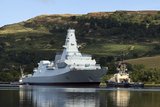
DCNS is nearing delivery of the FREMM Bretagne frigate to the French Navy, with the vessel floated at the company’s Lorient, France facility on 16 September.
A total of six FREMM frigates are on order for the French Navy, with delivery due to complete by mid-2019.
The vessels have been ordered by OCCAR as part of a larger programme that also called for DCNS to construct and deliver two FREMMs for the Royal Moroccan Navy and the Egyptian Navy. These vessels – Mohammed VI and Tahya Misr - were delivered in January 2014 and June 2015 respectively.
FREMM Bretagne is the fifth vessel for France. Three FREMMs have already been delivered, and – in addition to Bretagne – a further two are currently under construction. FREMM Auvergne will start sea trials at the end of September 2016, and assembly is set to begin shortly for FREMM Normandie.
France's FREMM frigates carry MU 90 torpedoes, Aster and Exocet MM 40 missiles, naval cruise missiles and the Herakles multifunctional radar. The vessels are 142m long, 20m wide, have a displacement of 6,000 tonnes, top speed of 27 knots and range of 6,000 tonnes. They can accommodate a crew of 108 people and 145 passengers.

You may also like

More from Naval Warfare
-
![What the rise of interoperability between Western allies means for defence procurement]()
What the rise of interoperability between Western allies means for defence procurement
Major naval initiatives including the European Patrol Corvette programmes and Norway’s UK partnership-focused purchase of Type 26 frigates point to the growing interest in the advantages of commonality across allied navies.
-
![Kraken’s Royal Navy USV contract signals next step in crewed-uncrewed integration]()
Kraken’s Royal Navy USV contract signals next step in crewed-uncrewed integration
The UK Royal Navy’s rapid procurement of uncrewed platforms aligns with the force’s strategic shift towards a fleet better equipped to handle modern threats.
-
![HMS Anson’s milestone stay in Australia cut short during AUKUS deployment]()
HMS Anson’s milestone stay in Australia cut short during AUKUS deployment
The Astute-class submarine’s visit to Australia was the first time maintenance activity on a UK Royal Navy nuclear submarine had been carried out in the country.
-
![How Operation Epic Fury could reduce US readiness to face China]()
How Operation Epic Fury could reduce US readiness to face China
The offensive against Iran could impact training and maintenance cycles and accelerate the degradation of the US arsenal on top of depleting Washington’s stockpiles.
-
![UK Royal Navy explores modular counter-drone capabilities for future hybrid fleet]()
UK Royal Navy explores modular counter-drone capabilities for future hybrid fleet
The UK MoD is scoping out systems to counter the growing threat of uncrewed aerial systems, with a focus on low-cost modularity and speed to field.