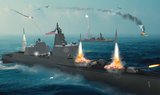
Croatian Navy fires RBS15


The Croatian Navy has fired the Saab RBS15 anti-ship missile from the Kralj-class missile boat Dmitar Zvonimir, marking the force’s first firing of the missile from a vessel.
The firing took place during Exercise Joint Force 15, held which was held in the ugen Kvaternik military training area, Slunj, and on the naval ranges at Dugi otok at the start of October.
The Croatian Navy previously fired the missile from a land-based launcher in May.
The RBS15 is designed for naval engagements from short distances to ranges well beyond the horizon. The surface-launched missile can be integrated on ships, land batteries and mobile launchers. It is also in service as an air-launched weapon that is integrated on the Gripen fighter and compatible with other NATO aircraft.
Gen Drago Lovric, Chief of General Staff of the Croatian Army, said: ‘The RBS15 missile is the primary armament of our missile gunboats and the firing of this missile indicates the purpose of the existence and the ability of these gunboats. Furthermore, we showed that the Croatian Navy is ready to defend every part of the territorial sea and target any enemy ship that jeopardises our national territory.’
Stefan Öberg, head of missile systems, Saab, said: ‘The target was completely destroyed by the missile in a testament to the maintainability and reliability of the RBS15, and the Croatian customer’s expertise and technical know-how.
‘We are very impressed by the exemplary manner in which the current system has been maintained and operated by the Croatian Navy. This level of expertise will surely mean that these missiles will remain in service with the Croatian Navy well into the future. We look forward to further collaboration with the Croatian MoD, on all fronts.

You may also like


More from Naval Warfare
-
![US turns to allies to tackle navy shipbuilding backlog]()
US turns to allies to tackle navy shipbuilding backlog
A White House memorandum acknowledges US Navy shipbuilding backlogs and a weakened industrial base, opening a formal path for South Korean and Japanese yards to help rebuild capacity.
-
![US Navy’s $275 billion BBGN plan hinges on shipyard transformation]()
US Navy’s $275 billion BBGN plan hinges on shipyard transformation
The US Navy’s planned nuclear-powered warship carries a US$275 billion price tag, but the greater story lies in the industrial overhaul needed to build it, from AI-enabled design to digital twins and modular construction.
-
![RTX confirms US Marine Corps and US Navy acquire Hadalus UUV]()
RTX confirms US Marine Corps and US Navy acquire Hadalus UUV
RTX told Shephard that the Hadalus UUV has been procured by the US Marine Corps and the Office of Naval Research for operational experimentation as the company prepares additional demonstrations with the US Navy, NATO and AUKUS partners.
-
![Europe’s naval contractors benefit from growing refit and upgrade demand]()
Europe’s naval contractors benefit from growing refit and upgrade demand
Rheinmetall’s order to modernise the German Navy frigate Bayern points to a wider European shift towards extending warship service life as new-build programmes face delay.