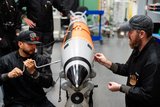
Lockheed receives JASSM FMS support contract


Lockheed Martin has been awarded a $99 million indefinite-delivery/indefinite-quantity contract for Joint Air-to-Surface Standoff Missile (JASSM) foreign military sales production support.
This contract will provide lifecycle support for work related to JASSM and any JASSM variants in the areas of system upgrades, integration, production, sustainment, management and logistical support, and is related to foreign military sales to Finland, Poland and Australia.
Work will be performed in Orlando, Florida, and is expected to be completed by August 2024.
The Air Force Life Cycle Management Center at Eglin Air Force Base, Florida, is the contracting activity for the award.
Related Equipment in Defence Insight




More from Defence Notes
-
![How deepening AI usage can boost efficiency and maximise effects for forces]()
How deepening AI usage can boost efficiency and maximise effects for forces
Saab has outlined how it is using artificial intelligence to make training more like electronic gaming, while the UK’s Power Size Technologies is applying the same technology to better evaluate and design vehicle capability, moving AI-enabled innovation further upstream from the frontline.
-
![From systems integrator to multi-domain solutions provider (video)]()
From systems integrator to multi-domain solutions provider (video)
Philipp von Brandenstein, Head of Corporate Communications at Rheinmetall, explains how Eurosatory 2026 marked a new stage in the company's evolution.
-
![US Pentagon pushes for major reform of defence acquisition system]()
US Pentagon pushes for major reform of defence acquisition system
The US Department of Defense has requested new contracting authorities from Congress, using the Army's MV-75 Cheyenne programme to demonstrate how competition, digital engineering and closer industry collaboration could accelerate acquisitions.
-
![US speeds up B61-13 nuclear bomb production as programme moves further ahead of schedule]()
US speeds up B61-13 nuclear bomb production as programme moves further ahead of schedule
The US government plans to accelerate production even further after achieving key B61-13 milestones months ahead of schedule, as the programme advances amid growing US-China strategic competition.
-
![Canada’s C$2 billion ACSV deal reinforces new defence industrial strategy as allies align]()
Canada’s C$2 billion ACSV deal reinforces new defence industrial strategy as allies align
General Dynamics Land Systems-Canada is the country’s first strategic partner under the Defence Industrial Strategy’s Strategic Partnership Framework, an effort to provide companies with confidence to invest and boost the defence labour force.