India receives first batch of ALS-50 loitering munitions from Tata
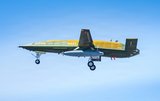
The Indian Air Force is now operating the ALS-50 loitering munition built by TASL. (Photo: TASL)
The first ASL-50 loitering munitions from Tata have been delivered to the Indian military.


The Indian Air Force (IAF) has received a first batch of indigenously designed loitering munitions, capable of operating in India’s diverse terrain and climatic environment.
Officials said private-sector Tata Advanced Systems Limited (TASL) had handed over the 2.5m-long, VTOL-capable Advanced Loitering System-50 (ALS-50). The IAF has ordered 100 units of this loitering munition.
With a 3.8m wingspan, it can deliver anti-personnel and antitank warheads weighing up to 6kg to a range of 50km.
Built of lightweight composites and with a cruise speed of 100km/h, the ALS-50 features a rectangular fuselage with rounded edges and shoulder-mounted wings fitted with underwing
Our news & analysis is now part of Defence Insight®
A Basic-level or higher Defence Insight subscription is now required to view this content.

More from Air Warfare
-
![India’s military integration drive faces interoperability hurdles]()
India’s military integration drive faces interoperability hurdles
Senior military leaders have highlighted the need for interoperable systems, common data standards and closer cooperation between India's armed services.
-
![UK A400M Saudi deployment highlights airlifter’s role as Airbus pursues upgrades]()
UK A400M Saudi deployment highlights airlifter’s role as Airbus pursues upgrades
Airbus is developing new capabilities for its A400M transport aircraft as European countries consider future airlift requirements and the UK plans to deploy the aircraft to Saudi Arabia.
-
![The new generation of defence companies emerging from the US UAV boom]()
The new generation of defence companies emerging from the US UAV boom
As the Pentagon accelerates procurement of low-cost, lethal UAVs through its Drone Dominance Program, emerging suppliers will need to demonstrate manufacturing capacity, supply chain resilience and reliability.
-
![US Coast Guard faces key procurement decisions after C-130J and MQ-9B orders]()
US Coast Guard faces key procurement decisions after C-130J and MQ-9B orders
The service is updating several parts of its aviation fleet including fixed-wing and rotary-wing aircraft and procuring uncrewed aircraft to boost its maritime surveillance.