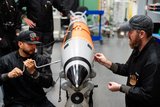
Raytheon wins DARPA TBG contract modification
The Defense Advanced Research Projects Agency (DARPA) has awarded Raytheon a contract modification for the Tactical Boost Glide (TBG) programme, it was announced on 29 April.
Under the contract modification worth $20.49 million, Raytheon will develop and demonstrate the technology to enable air-launched hypersonic boost glide systems. Once fielded, TBG could fly faster than Mach 5 and at altitudes of nearly 200,000ft.
Hypersonic weapons would be difficult to intercept, and would enable warfighters to strike targets at long range much more quickly than current missile technology allows.
Tom Bussing, vice president of advanced missile systems, Raytheon, said: ‘Hypersonics is the new frontier of missile design and development.
‘The extreme environments where these advanced missiles must operate present significant engineering challenges. Our extensive experience and expertise in developing advanced guided weapon systems uniquely position Raytheon to help solve these problems and deliver these solutions.’
To achieve the required speeds, the re-entry vehicles would be designed to skip across the inside of Earth’s upper atmosphere before descending on their targets. The new missiles would have to withstand intense heat while remaining highly manoeuvrable, and would require sensor packages to engage moving or re-locatable targets.



You may also like

More from Defence Notes
-
![US speeds up B61-13 nuclear bomb production as programme moves further ahead of schedule]()
US speeds up B61-13 nuclear bomb production as programme moves further ahead of schedule
The US government plans to accelerate production even further after achieving key B61-13 milestones months ahead of schedule, as the programme advances amid growing US-China strategic competition.
-
![New UK armed forces minister frames High North defence as vital to “homeland security”]()
New UK armed forces minister frames High North defence as vital to “homeland security”
The UK’s Minister for the Armed Forces Louise Sandher-Jones made her first appearance in the role before the House of Commons Defence Committee this week to highlight efforts to improve capability in the High North.
-
![Canada seeks to strengthen industrial ties with the US on classified programmes]()
Canada seeks to strengthen industrial ties with the US on classified programmes
Ottawa explores expanding defence-industrial cooperation with Washington into sensitive programmes, an approach that could reshape NORAD modernisation, strengthen North American supply chains and create new opportunities for defence contractors.
-
![UK’s latest defence robotics and autonomy competition looks to break new ground]()
UK’s latest defence robotics and autonomy competition looks to break new ground
The UK Ministry of Defence is backing early-stage, high-risk autonomy concepts that could redefine how military systems are developed and deployed.
-
![How AI is reshaping defence procurement through sustainment]()
How AI is reshaping defence procurement through sustainment
Artificial intelligence is not just changing how defence equipment is maintained but how defence programmes are won, creating new opportunities for industry by influencing acquisition decisions and shaping competition.