UK welcomes RFA Proteus, the UK’s first dedicated underwater surveillance ship
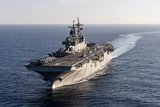
RFA Proteus has a flight deck and a 1,000sqm cargo deck, plus a heavy-duty crane. (Photo: Crown Copyright)
The UK has commemorated the arrival of Royal Fleet Auxiliary (RFA) Proteus, the country’s first ship dedicated to underwater surveillance, equipped with advanced capabilities and remotely-operated vehicles (ROVs) for seabed warfare operations.


The ship will be operated by RFA, the UK Royal Navy’s (RN’s) support arm, and was formally dedicated on 10 October. Proteus will serve as a testbed for advancing science and technological development.
The UK MoD committed to the purchase less than year ago as the first ship in its Multi-Role Ocean Surveillance (MROS) programme which includes plans for a second locally-built ship.
The ship was converted from the commercial vessel MV Topaz Tangaroa which was designed and built by Vard. It had previously conducted commercial subsea work, including surveys and operating ROVs.
Since arriving at the Cammell Laird yard in Birkenhead in January, the 6,000t vessel has undergone conversion to fit for purpose.
Crewed by 26 RFA officers and sailors, augmented by 60 Royal Navy specialists responsible for the undersea surveillance, survey and warfare systems, the ship began life as an oil rig-support vessel.
It left Merseyside in September to undergo trials and training off Portland.
It is equipped with a flight deck and a 1,000sqm cargo deck, plus a heavy-duty crane for lifting and lowering operations.


More from Naval Warfare
-
![How could Rheinmetall’s GMF 140 fit with ongoing programmes in North America?]()
How could Rheinmetall’s GMF 140 fit with ongoing programmes in North America?
With Canada committed to its River-class replacement and the USN pursuing a lower-cost frigate, Rheinmetall will need to demonstrate where the GMF 140 can fill a capability gap in the North American fleet.
-
![Australian industry programme builds pipeline for Virginia-class sustainment]()
Australian industry programme builds pipeline for Virginia-class sustainment
Australian businesses can now bid to support Virginia-class submarine sustainment in Western Australia, as momentum around the Henderson Defence Precinct also builds.
-
![South Korea, Japan and Turkey vie for US shipbuilding access in future frigate contest]()
South Korea, Japan and Turkey vie for US shipbuilding access in future frigate contest
Washington’s search for a foreign-built frigate could hand South Korea, Japan and Turkey a larger prize than a double-hull order: a foothold inside the US shipbuilding industrial base.
-
![Japan’s FY2027 budget bets on stand-off systems to offset demographic decline]()
Japan’s FY2027 budget bets on stand-off systems to offset demographic decline
Japan’s FY2027 defence budget backs stand-off strike, a 17-aircraft MQ-9B buy and a declared bid to lead the world in uncrewed maritime assets, alongside new frigates, submarines and support ships.