Taiwan president watches naval drill as China tensions grow


Taiwan’s President Tsai Ing-wen watched naval drills simulating an attack on the island on 13 April, days before Beijing is set to hold live-fire exercises nearby in a show of force.
Relations between self-ruling Taiwan and China have deteriorated since Tsai Ing-wen came to power almost two years ago, largely because she refuses to accept the ‘One China’ formula governing relations.
Beijing regards the island as its territory – to be reunited by force if necessary – even though the two sides split in 1949 after a civil war.
China’s growing military is increasingly flexing its muscles and will hold live-fire drills in the week of 16 April in the Taiwan Strait – the narrow waterway separating the Chinese mainland from Taiwan – following weeks of naval manoeuvres in the area.
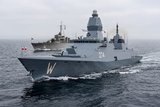
Tsai boarded the Kee Lung destroyer to supervise as troops practised defending against an attack on the northeastern port of Suao.
It was the first time she has supervised a drill from onboard a warship.
Tsai said on the destroyer’s deck after it returned to port as the exercise ended: ‘I believe our countrymen will have great faith in the military’s combat capabilities and its determination to defend our country after today’s drill.’
Tsai said ‘we are very confident of our military’ when asked to comment on Beijing’s planned live-fire drill in the Taiwan Strait.
She added: ‘It’s a routine drill that our military will fully monitor and has made relevant preparations.’
Taiwan’s Defence Ministry said the exercise was staged in light of a ‘changing international and regional security situation’ to test the military’s combat readiness and its ability to defend Taiwanese territory.
Some 20 warships and four F16 fighter jets took part in the drill, one of the largest naval manoeuvres since Tsai took office in May 2016.
Tsai has warned against what she called Beijing’s “military expansion” -- the increase in Chinese air and naval drills around the island since she took office in May 2016.
Chinese warplanes conducted 25 drills around Taiwan between August 2016 and mid-December 2017, according to Taipei.
On 12 April, Chinese President Xi Jinping made a surprise visit to naval forces in the disputed South China Sea, where he stressed the ‘urgent’ need to build a powerful navy.
China’s sole aircraft carrier, the Liaoning, sailed through the Taiwan Strait on 20 March, the same day that Xi issued a public warning against attempts to ‘separate’ from China.
Xi’s naval visit came after a US aircraft carrier sailing though the South China Sea gave a demonstration on 10 April for members of the Philippine government.
Washington recently agreed to allow US defence contractors help Taiwan construct its own submarines, sparking a warning from Beijing to Taipei against ‘playing with fire to burn itself’.

More from Naval Warfare
-
![Autonomy gives Turkey a chance to outflank established naval shipbuilders]()
Autonomy gives Turkey a chance to outflank established naval shipbuilders
Turkish shipbuilders have sold ships from Asia to Europe, but autonomy and swarm technology could give them a fairer fight against Western European rivals.
-
![Canada assesses security equipment changes for Polar Icebreaker Imnaryuaq]()
Canada assesses security equipment changes for Polar Icebreaker Imnaryuaq
The Canadian Department of National Defence is evaluating communications and reconnaissance changes for CCGS Imnaryuaq’s expanded maritime security role, while retaining its 2032 acceptance target.
-
![US Navy’s MQ-25 Stingray approaches carrier-integration tests]()
US Navy’s MQ-25 Stingray approaches carrier-integration tests
Boeing has outlined its upcoming precision-landing and carrier-airspace trials as MQ-25 manufacturing shifts towards Illinois, with initial Lot 1 deliveries expected in 2029.
-
![From Poland to the Pacific: can Miecznik become a blueprint for other navies?]()
From Poland to the Pacific: can Miecznik become a blueprint for other navies?
Babcock is taking its Polish industrial partnership approach to Denmark and New Zealand as navies seek sovereign shipbuilding skills alongside ships.