


Suppliers await next step in Australia’s mine warfare transition
Australia’s mine countermeasure capability remains in flux as the Huon-class nears retirement, but accelerated investment in autonomous systems is opening a path for industry.


Rockwell Collins has introduced its new DF-500 direction finder system, designed to efficiently pinpoint distress signals and enable search and rescue (SAR) aircraft to receive and locate Emergency Position-Indicating Radio Beacon (EPIRB) signals.
The DF-500 succeeds the older-generation DF-430 direction finder, which is used by government and military SAR operators. The DF-500 is backwards compatible with the DF-430 and has a solid-state antenna that can be added to the mounting provisions of the DF-301E direction finding antenna system.
The system features software-defined radio technology for higher sensitivity, stability of bearing indications and immunity to interferences. It has new features, such as multi-channel scanning and real-time monitoring, fast scanning and interoperability with automatic identification system and maritime digital selective calling distress protocols. Its multi-channel architecture allows it to simultaneously monitor key frequencies and detect V/UHF radio distress/safety calls or emergency beacons.
Troy Brunk, vice president and general manager, airborne solutions, Rockwell Collins, said: ‘When it comes to airborne SAR missions, saving time is often the difference between a rescue and a recovery. That’s why civilian, government and military SAR organisations are upgrading their aircraft’s direction-finder capabilities with Rockwell Collins’ DF-500 direction finder.’

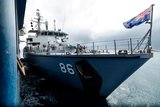
Australia’s mine countermeasure capability remains in flux as the Huon-class nears retirement, but accelerated investment in autonomous systems is opening a path for industry.
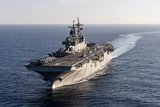
As the Iran War draws US ships and marine corps units away from the Indo-Pacific, curtailed exercises and a temporary carrier gap are exposing tensions between Washington’s demand for more self-reliant allies and the joint training needed to realise that ambition.
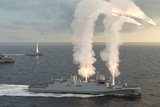
With Canada committed to its River-class replacement and the USN pursuing a lower-cost frigate, Rheinmetall will need to demonstrate where the GMF 140 can fill a capability gap in the North American fleet.

Australian businesses can now bid to support Virginia-class submarine sustainment in Western Australia, as momentum around the Henderson Defence Precinct also builds.
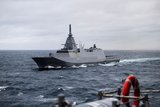
Washington’s search for a foreign-built frigate could hand South Korea, Japan and Turkey a larger prize than a double-hull order: a foothold inside the US shipbuilding industrial base.
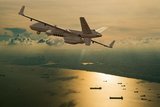
Japan’s FY2027 defence budget backs stand-off strike, a 17-aircraft MQ-9B buy and a declared bid to lead the world in uncrewed maritime assets, alongside new frigates, submarines and support ships.

Connect with us on socials


