First 3D metal part for US Navy vessel


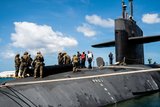
Huntington Ingalls Industries’ Newport News Shipbuilding has delivered the first 3D-printed metal part for installation on the US Navy’s aircraft carrier USS Harry S Truman, the company announced on the 29 January.
The part – a piping assembly – will be evaluated for a one-year period onboard the nuclear-powered aircraft carrier. In 2018, NAVSEA approved the technical standards for 3D printing after extensive collaboration with the company and industry partners that involved the rigorous printing of test parts and materials, and extensive development of an engineered test programme.
Charles Southall, VP of engineering and design, Newport News Shipbuilding, said: ‘We are pleased to have worked so closely with our navy partners to get to the point where the first 3D metal part will be installed on an aircraft carrier.
‘The advancement of additive manufacturing will help revolutionise naval engineering and shipbuilding. It also is a significant step forward in our digital transformation of shipbuilding processes to increase efficiency, safety and affordability.’

More from Naval Warfare
-
![US Navy’s $275 billion BBGN plan hinges on shipyard transformation]()
US Navy’s $275 billion BBGN plan hinges on shipyard transformation
The US Navy’s planned nuclear-powered warship carries a US$275 billion price tag, but the greater story lies in the industrial overhaul needed to build it, from AI-enabled design to digital twins and modular construction.
-
![Industry sees opportunity in Australia’s shift to networked undersea warfare]()
Industry sees opportunity in Australia’s shift to networked undersea warfare
Australia’s new defence innovation strategy indicates a shift from platform-centric to network-centric undersea warfare, with Ocius and Anduril Industries pointing to fast-growing opportunities for local industry.
-
![Asia-Pacific emerges as the largest export market for US-made USVs]()
Asia-Pacific emerges as the largest export market for US-made USVs
Asian customers have placed one of the largest known international purchases of US-built uncrewed surface vessels, highlighting accelerating regional demand for autonomous maritime capabilities and distributed naval operations.