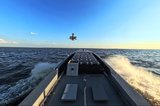
Extensive Russian submarine operation in North Atlantic: Norway
Russia has sent about 10 submarines into the North Atlantic in the largest such operation since the end of the Cold War, the Norwegian military said on 29 October.
Since last week, the Russian submarines – based on the Kola Peninsula in Russia’s far north – have been dispatched for manoeuvres in the Atlantic Ocean, according to information from the Norwegian Intelligence Service, first reported by broadcaster NRK and later confirmed to AFP.
‘There’s a lot of activity in the North Atlantic at the moment and Norway together with other NATO states are monitoring with air and surface capabilities,’ Brynjar Stordal, a spokesman for the Norwegian armed forces, told AFP.
This is the largest operation of its kind conducted by Russia ‘since the end of the Cold War by the number of assets operating at the same time,’ he added.
According to sources cited by NRK, the Russian submarines, which all left their base in submerged mode, are seeking to reach as far into the Atlantic as possible – ideally waters west of Greenland – without being detected.
The operation is planned to last about two months with the suspected goal ‘to show that they are able to threaten the east coast of the United States.’
‘Of course they’re showing their capabilities both in numbers and as to what they can deploy at the same time,’ Stordal said.
On 26 October, Russian news agencies reported two nuclear submarines, Nizhny Novgorod and Pskov, were preparing for ‘deep dives to test certain equipment and weapons’ in the neutral waters of the Norwegian Sea.
‘During these dives, which will last a week, their crews will practice tactical procedures and different techniques for deep manoeuvres,’ according to a statement from the Russian North Fleet, quoted by the agencies.
The Norwegian Sea has depths of several thousand meters, unlike the Barents Sea outside the Russian port of Murmansk which only has an average depth of about 200 metres.
According to Russian media the two submarines are so called Kondor-class – or Sierra-class – multipurpose subs, which are equipped to launch cruise missiles and designed to detect and destroy enemy air and sea targets.



You may also like
More from Naval Warfare
-
![How could Rheinmetall’s GMF 140 fit with ongoing programmes in North America?]()
How could Rheinmetall’s GMF 140 fit with ongoing programmes in North America?
With Canada committed to its River-class replacement and the USN pursuing a lower-cost frigate, Rheinmetall will need to demonstrate where the GMF 140 can fill a capability gap in the North American fleet.
-
![Australian industry programme builds pipeline for Virginia-class sustainment]()
Australian industry programme builds pipeline for Virginia-class sustainment
Australian businesses can now bid to support Virginia-class submarine sustainment in Western Australia, as momentum around the Henderson Defence Precinct also builds.
-
![South Korea, Japan and Turkey vie for US shipbuilding access in future frigate contest]()
South Korea, Japan and Turkey vie for US shipbuilding access in future frigate contest
Washington’s search for a foreign-built frigate could hand South Korea, Japan and Turkey a larger prize than a double-hull order: a foothold inside the US shipbuilding industrial base.
-
![Japan’s FY2027 budget bets on stand-off systems to offset demographic decline]()
Japan’s FY2027 budget bets on stand-off systems to offset demographic decline
Japan’s FY2027 defence budget backs stand-off strike, a 17-aircraft MQ-9B buy and a declared bid to lead the world in uncrewed maritime assets, alongside new frigates, submarines and support ships.
-
![Russia’s uncrewed boat portfolio hints at future naval demand]()
Russia’s uncrewed boat portfolio hints at future naval demand
Ukrainian intelligence has catalogued more than 20 Russian uncrewed surface vessels, revealing a portfolio weighted towards mine warfare and logistics, with implications for Western naval investment.
-
![Ukraine’s new long-range 12m autonomous vessel can deploy other drones]()
Ukraine’s new long-range 12m autonomous vessel can deploy other drones
Ukraine’s UForce unveiled the MV11 uncrewed surface vessel, designed to launch and support other naval drones at sea, fuelling debate over the future of autonomous maritime task groups.