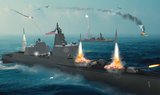
DCNS demonstrates Polaris system


DCNS has conducted three demonstrations of the Polaris mission systems in the coastal waters of the Gulf of Guinea, the company announced on 8 July.
The demonstrations were carried out with the NIDL interoperable tactical data link solution and during French Navy patrol vessel L’Adroit’s stopovers in Cameroon, Ivory Coast and Senegal; Douala, Cameroon on 28 May; Abidjan, Ivory Coast on 10 June; and Dakar, Senegal on 22 June.
A sea-rescue and offender interception scenario was simulated to deploy the Polaris mission system on board the vessel and in a land-based centre. The real-time transmission of data between the land-based centre and vessel was supported by the navies of Cameroon, Ivory Coast and Senegal.
DCNS integrates the NIDL module in the Polaris system to form an interoperable intelligence-gathering and surveillance system that facilitates tactical files and data exchanges.
Xavier Mesnet, marketing and development director, DCNS, said: ‘Working together with the French Navy, DCNS participates in numerous support operations to strengthen the maritime security system and government action at sea.
‘Faced with an increase in criminal (piracy, drugs trafficking) and illicit (illegal fishing, illegal immigration, pollution) activities, the group is developing open-architecture and modular maritime surveillance and intervention solutions to provide a response to the sovereignty needs of states, including within the context of coalition operations.’




More from Naval Warfare
-
![FNSS looks to put uncrewed vehicles at the front of amphibious assaults]()
FNSS looks to put uncrewed vehicles at the front of amphibious assaults
The new platform is designed to put reconnaissance, obstacle clearance and fire support ahead of the crewed force in a contested landing.
-
![US turns to allies to tackle navy shipbuilding backlog]()
US turns to allies to tackle navy shipbuilding backlog
A White House memorandum acknowledges US Navy shipbuilding backlogs and a weakened industrial base, opening a formal path for South Korean and Japanese yards to help rebuild capacity.
-
![US Navy’s $275 billion BBGN plan hinges on shipyard transformation]()
US Navy’s $275 billion BBGN plan hinges on shipyard transformation
The US Navy’s planned nuclear-powered warship carries a US$275 billion price tag, but the greater story lies in the industrial overhaul needed to build it, from AI-enabled design to digital twins and modular construction.