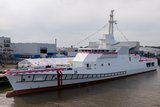
Babcock, BMT enter partnership
Babcock and BMT have signed a cooperation agreement that will see the companies collaborate to support the design, build, construction and support of future classes of surface ships for the UK Ministry of Defence (MoD) and other international projects, BMT announced on 7 November.
BMT said the companies will initially focus on the UK’s recently announced Type 31e frigate programme.
Under the partnership, Babcock and BMT will combine their strengths to deliver innovative, capable, affordable and flexible customer solutions. Both companies will jointly explore their available designs to determine the best possible option that meets the cost, capability, and delivery requirements of the Royal Navy.
Jeremy Berwick, managing director for defence at BMT, said: ‘This is the beginning of a deeper strategic relationship with Babcock founded on many years of working together successfully both with the Royal Navy and navies around the globe.
‘The T31e programme is the catalyst where excellence of design, innovation and certainty of delivery combine to offer a highly credible contender for the Royal Navy’s next warship. The agreement will provide a strong basis for understanding and serving the different needs of many other navies.’



You may also like

More from Naval Warfare
-
![Argentina’s submarine and frigate acquisitions resurface with $3.5bn funding plan]()
Argentina’s submarine and frigate acquisitions resurface with $3.5bn funding plan
Buenos Aires set out foreign loans worth $3.5 billion in its draft 2027 budget, opening a contest in which Naval Group and TKMS could lead the field.
-
![AUKUS heavyweight torpedo test raises questions over future armed UUV requirements]()
AUKUS heavyweight torpedo test raises questions over future armed UUV requirements
A heavyweight torpedo firing from the Royal Navy’s uncrewed submarine XV Excalibur suggests a shift beyond surveillance, with allied navies eyeing strike roles for large autonomous undersea vessels.
-
![Industrial teams prepare roadmap for Indonesia aircraft carrier transformation]()
Industrial teams prepare roadmap for Indonesia aircraft carrier transformation
Fincantieri and PT PAL have agreed on a framework to modernise the former Giuseppe Garibaldi, with drones, communications and broader Italian–Indonesian industrial ties involved.
-
![Five years on: where could opportunities emerge next for AUKUS Pillar II?]()
Five years on: where could opportunities emerge next for AUKUS Pillar II?
Payload commonality, combat systems and electronic warfare are emerging as likely priorities as the trilateral partnership balances building submarines with sharing industrial ecosystems.
-
![Singapore expands maritime presence with future-ready Sentinel OPV]()
Singapore expands maritime presence with future-ready Sentinel OPV
Singapore is building space for uncrewed systems and future technologies into its new Sentinel-class OPVs, reflecting a wider move towards adaptable vessels capable of maintaining persistent maritime presence.