Australia orders first Naval Strike Missiles
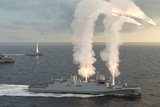
Australia is buying Naval Strike Missiles to replace Harpoons on its current frigates and destroyers. (Photo: Kongsberg)
Australia has ordered its first anti-ship missiles from Norway to equip its surface warships.


On 5 July, the Australian government announced it had ordered, under an accelerated acquisition, an unspecified number of Naval Strike Missiles (NSM).
Kongsberg Defence and Aerospace revealed in a press statement on the following day that this initial contract was worth NOK489 million ($48.6 million).
The NSMs will replace Harpoon anti-ship missiles on both Anzac-class frigates and Hobart-class destroyers of the Royal Australian Navy.
Øyvind Kolset, Executive VP Missile Systems at Kongsberg Defence and Aerospace, stated, ‘Signing this initial contract to commence the acquisition of an Australian NSM capability is a very important milestone.’
He said it was a clear demonstration of the company’s commitment to the accelerated delivery of NSMs.
Kongsberg describes the Norwegian-developed NSM as ‘a fifth-generation, long-range, precision strike missile’.
Related Equipment in Defence Insight



More from Naval Warfare
-
![Can the US Navy ask Indo-Pacific allies to do more while training with them less?]()
Can the US Navy ask Indo-Pacific allies to do more while training with them less?
As the Iran War draws US ships and marine corps units away from the Indo-Pacific, curtailed exercises and a temporary carrier gap are exposing tensions between Washington’s demand for more self-reliant allies and the joint training needed to realise that ambition.
-
![How could Rheinmetall’s GMF 140 fit with ongoing programmes in North America?]()
How could Rheinmetall’s GMF 140 fit with ongoing programmes in North America?
With Canada committed to its River-class replacement and the USN pursuing a lower-cost frigate, Rheinmetall will need to demonstrate where the GMF 140 can fill a capability gap in the North American fleet.
-
![Australian industry programme builds pipeline for Virginia-class sustainment]()
Australian industry programme builds pipeline for Virginia-class sustainment
Australian businesses can now bid to support Virginia-class submarine sustainment in Western Australia, as momentum around the Henderson Defence Precinct also builds.
-
![South Korea, Japan and Turkey vie for US shipbuilding access in future frigate contest]()
South Korea, Japan and Turkey vie for US shipbuilding access in future frigate contest
Washington’s search for a foreign-built frigate could hand South Korea, Japan and Turkey a larger prize than a double-hull order: a foothold inside the US shipbuilding industrial base.
-
![Japan’s FY2027 budget bets on stand-off systems to offset demographic decline]()
Japan’s FY2027 budget bets on stand-off systems to offset demographic decline
Japan’s FY2027 defence budget backs stand-off strike, a 17-aircraft MQ-9B buy and a declared bid to lead the world in uncrewed maritime assets, alongside new frigates, submarines and support ships.