Aegis Virtual Twin intercepts first target


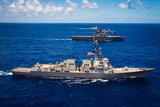
The US Navy successfully executed the first live-fire engagement with the new Aegis Virtual Twin system, prototype of the Aegis virtual combat management system, from the USS Thomas Hudner off the coast of Virginia on 25 March.
During the exercise, the system fired an SM-2 missile against an incoming target, to validate its performance for controlling radars and missiles to execute an engagement.
Using virtualisation technology, the system is able to run the Aegis weapon system code in a fraction of the original hardware space. The Virtual Twin was installed on the Thomas Hudner in rugged cases. In future designs, the reduced size will free up ship board space, providing room to field increased capabilities.
Related Equipment in Defence Insight




More from Naval Warfare
-
![US weighs offshore warship production due to industrial limits]()
US weighs offshore warship production due to industrial limits
A Pentagon push to procure warships from Japanese and South Korean shipyards could reshape allied naval industrial strategy, but critics warn the approach risks hollowing out the domestic base Washington is seeking to restore.
-
![Lessons shaping the next phase of Arleigh Burke production post-Flight IIA]()
Lessons shaping the next phase of Arleigh Burke production post-Flight IIA
The accelerated delivery of the final Flight IIA destroyer, USS Patrick Gallagher, showcases the payoff of years of workforce investment and process reform at Bath Iron Works, with the lessons feeding into Flight III production.
-
![Ukraine war drives ‘minimum deployable capability’ doctrine in uncrewed systems development]()
Ukraine war drives ‘minimum deployable capability’ doctrine in uncrewed systems development
Ukraine’s battlefield has rewritten the rules of uncrewed systems development. For Syos Aerospace, real-time operator feedback, lean serial production and a system-of-systems philosophy are central to its operating model.
-
![Sealift shortfalls set to drive opportunities across NATO navies]()
Sealift shortfalls set to drive opportunities across NATO navies
A new Council on Geostrategy primer warns that NATO cannot defend its own supply lines. As the alliance faces a sealift and logistics escort deficit, a wave of unawarded procurement is beginning to take shape.