Bradley gets stereo vision system


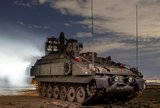
The US Army’s Tank Automotive Research, Development and Engineering Center (TARDEC), working with Honeywell Aerospace, has installed a prototype helmet‐mounted stereo vision system into a Bradley Fighting Vehicle, the US Army announced on 2 July.
The prototype system was originally developed under DARPA’s Ground X Vehicle Technologies (GXV‐T) programme.
In its current configuration, the Bradley vehicle can only be driven closed‐hatched with the driver looking through mirrored sights with a limited field of view, in order to protect the crew.
TARDEC’s Mission Enabling Technologies‐Demonstrator team added the Honeywell Aerospace technology to the Bradley’s existing suite of 360° situational awareness sensors. The system includes a wide range of forward facing stereo camera pairs whose imagery is projected into the left and right eye of the user through a pair of holographic optical elements. This allows the user to perceive depth while showing a wide field of regard without causing nausea or eye strain.
Additional standard and fish‐eye lens cameras provide complimentary views of the vehicle’s perimeter position and mid‐range detection.
The installation is intended to demonstrate a proof‐of‐concept for closed‐hatch driving using high resolution stereo vision combined with advanced head tracking technology integrated into a helmet mounted display.
Related Equipment in Defence Insight

More from Land Warfare
-
![Europe commits to long-range fires but countries move in different directions]()
Europe commits to long-range fires but countries move in different directions
Sweden, Croatia and France are pursuing different rocket artillery solutions as European armies seek greater reach, survivability and industrial resilience.
-
![Polaris expands Arctic mobility offering as US military orders grow]()
Polaris expands Arctic mobility offering as US military orders grow
The Military 850 Voyageur 155 Crossover has secured orders from the US Army, Air Force and Marine Corps, addressing demand for agile Arctic mobility with passenger, cargo and towing capacity.
-
![UK’s ground-based air defence effort remains in assessment phase after third industry day]()
UK’s ground-based air defence effort remains in assessment phase after third industry day
The UK’s plan to introduce a new air defence capability into the British Army will cover short and medium-range defence as well as counter-uncrewed aerial system systems. Timelines are not yet laid out but industry is making plans.