Italy receives seventh FREMM frigate
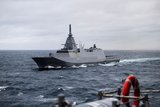
The Italian Navy has received its newest FREMM frigate, Federico Martinengo, at Fincantieri’s shipyard in Muggiano, La Spezia, Fincantieri announced on 24 April.
The frigate - delivered in multipurpose configuration - is the seventh of a series of ten Multi Mission European Frigates being built by Fincantieri as part of the Italian-French FREMM programme, coordinated by the Organisation for Joint Armament Cooperation. Orizzonte Sistemi Navali (51% Fincantieri and 49% Leonardo) is the prime contractor for Italy in the FREMM programme.
The FREMM frigates are 144 meters in length with a displacement at full load of approximately 6,700 tons. The vessels are designed to reach a maximum speed of 27 knots and to provide accommodation for 200 people including crew and staff.
In Italian Navy service the vessels will replace the Lupo and Maestrale classes of vessels, both built by Fincantieri in the 1970s. The vessels will become the backbone of the naval fleet over the next decades, carrying out a range of military and humanitarian operations.



You may also like


More from Naval Warfare
-
![Australian industry programme builds pipeline for Virginia-class sustainment]()
Australian industry programme builds pipeline for Virginia-class sustainment
Australian businesses can now bid to support Virginia-class submarine sustainment in Western Australia, as momentum around the Henderson Defence Precinct also builds.
-
![South Korea, Japan and Turkey vie for US shipbuilding access in future frigate contest]()
South Korea, Japan and Turkey vie for US shipbuilding access in future frigate contest
Washington’s search for a foreign-built frigate could hand South Korea, Japan and Turkey a larger prize than a double-hull order: a foothold inside the US shipbuilding industrial base.
-
![Russia’s uncrewed boat portfolio hints at future naval demand]()
Russia’s uncrewed boat portfolio hints at future naval demand
Ukrainian intelligence has catalogued more than 20 Russian uncrewed surface vessels, revealing a portfolio weighted towards mine warfare and logistics, with implications for Western naval investment.
-
![Ukraine’s new long-range 12m autonomous vessel can deploy other drones]()
Ukraine’s new long-range 12m autonomous vessel can deploy other drones
Ukraine’s UForce unveiled the MV11 uncrewed surface vessel, designed to launch and support other naval drones at sea, fuelling debate over the future of autonomous maritime task groups.
-
![German Navy’s Israeli missile test points to deepening defence-industrial ties]()
German Navy’s Israeli missile test points to deepening defence-industrial ties
The test-firing of an Israel Aerospace Industries LORA ballistic missile from a German vessel highlights the Bundeswehr’s focus on speed to capability as it trials Israel’s operationally proven technology.