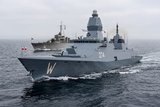
FREMM Tahya Misr sails for home port


The Egyptian Navy’s new FREMM Tahya Misr has left for its home port in Alexandria, Egypt from the French Navy’s Brest military port, DCNS announced on 24 July.
The vessel left the port six months after DCNS signed the contract to supply the multi-mission frigate to Egypt. Training of Egyptian Navy personnel began in March 2015 in preparation for the navy to take delivery of the ship.
The training programme includes theoretical modules, on-land training with platforms and simulators, and on-board training at the quayside and at sea.
The FREMM was transferred to the Egyptian Navy on 23 June, and DCNS and partners will accompany the crew for 15 months to help operate the ship. The company will also provide support services and through life support in Egypt for five years.
The FREMM Tahya Misr frigate is fitted with the DCNS SETIS combat system to counter air, surface, land-based and submarine threats. It has Aster and Exocet MM 40 missiles, a Herakles multifunction radar and MU 90 torpedoes.



More from Naval Warfare
-
![Canada assesses security equipment changes for Polar Icebreaker Imnaryuaq]()
Canada assesses security equipment changes for Polar Icebreaker Imnaryuaq
The Canadian Department of National Defence is evaluating communications and reconnaissance changes for CCGS Imnaryuaq’s expanded maritime security role, while retaining its 2032 acceptance target.
-
![US Navy’s MQ-25 Stingray approaches carrier-integration tests]()
US Navy’s MQ-25 Stingray approaches carrier-integration tests
Boeing has outlined its upcoming precision-landing and carrier-airspace trials as MQ-25 manufacturing shifts towards Illinois, with initial Lot 1 deliveries expected in 2029.
-
![From Poland to the Pacific: can Miecznik become a blueprint for other navies?]()
From Poland to the Pacific: can Miecznik become a blueprint for other navies?
Babcock is taking its Polish industrial partnership approach to Denmark and New Zealand as navies seek sovereign shipbuilding skills alongside ships.
-
![Unsettled waters in the North: can navies still trust their Arctic acoustic maps?]()
Unsettled waters in the North: can navies still trust their Arctic acoustic maps?
The changing Arctic environment is creating new challenges for submarine detection, driving demand for distributed sensors, uncrewed underwater vehicles and real-time acoustic modelling.