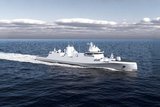
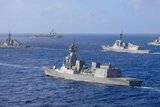
Damen, Mexican Navy building POLA vessel


Damen Shipyards Group and the Mexican Navy are working together to build a Long Range Ocean Patrol (POLA) vessel, the company announced on 26 June.
With a length of 107m and a beam of 14m, the POLA vessel will be the Mexican version of the Damen’s SIGMA 10514. It will be able to sail at speeds of over 25 knots with a capacity of more than 20 days at sea.
Damen will build two of the six modular sections of the vessel at the Damen Schelde Naval shipyard in the Netherlands. The remaining four modules will be built in Mexico. The construction of these modules, along with the integration, will be carried out at a yard that cooperates on this with Damen.
During the construction of the modules in Europe, a Mexican team will be in the Netherlands to supervise the process and to receive knowledge transfer.
The first of the Dutch modules has already arrived in Mexico, where it is being integrated with two of those already built in Salina Cruz. The hull of the vessel has already been completed in drydock. It will now be prepared to receive the other three superstructure modules.
The POLA vessel will be capable of carrying out various missions including long range SAR, surveillance and patrol operations, and humanitarian relief.
The flagging ceremony of the POLA is planned for November 2018. A full integrated process of setting to work, commissioning, training, tests and trials will continue in 2019.


More from Naval Warfare
-
![GMF 140: Rheinmetall’s transatlantic ambitions for NATO’s future surface fleet]()
GMF 140: Rheinmetall’s transatlantic ambitions for NATO’s future surface fleet
Pitched to the US, the guided missile frigate may find its first orders in Germany, Denmark or Belgium as the company seeks a standard design for allied navies.
-
![Schiebel sees progress in South Korea and Greece despite cautious shipbuilders]()
Schiebel sees progress in South Korea and Greece despite cautious shipbuilders
The Camcopter S-300 remains on track for South Korea and was in the hunt in France, but shipbuilders remain guarded, a cooler mood than at Eurosatory.
-
![US Navy explores 3D-printed parts for Growler, Poseidon and Arleigh Burke destroyers]()
US Navy explores 3D-printed parts for Growler, Poseidon and Arleigh Burke destroyers
USN procurement notices point to potential uses for additive manufacturing in naval aviation and shipbuilding.
-
![Who commands the uncrewed systems when the mothership goes down?]()
Who commands the uncrewed systems when the mothership goes down?
In October 2026, the US Navy sent an uncrewed surface vessel to sea with a carrier strike group for the first time. It is a step forward for hybrid operations, but it raises an awkward question: what happens to the drones if the ship controlling them is lost?