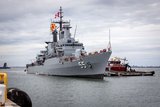
French Navy’s Normandie frigate continues sea trials


The second frigate of the French Navy’s FREMM programme, Normandie, has completed its third series of sea trials off the Brittany coast. The vessel returned to port at the DCNS site in Lorient on 8 March.
The trials, which lasted one week, were conducted to allow DCNS teams and French Navy crew to verify the vessel’s performance; and test the performance of various combat-system sensors and the Syracuse communication station.
Tests were conducted on the propulsion system and, in particular, on the CODLOG (COmbined Diesel eLectric Or Gas) hybrid system. This propulsion system allows the FREMMs to advance silently at low speed – thanks to the electric motors – or reach speeds in excess of 27 knots thanks to the vessel’s gas turbine. In addition to these propulsion tests, the DCNS teams also verified the navigation systems (speed calculations, position, bearing) as well as the inertial units, which allow a very precise positioning of the vessel whatever its location on the oceans.
These trials followed initial phases of testing in November 2012 and January 2013. During the January phase, the frigate made its first stopover in Brest, which allowed the verification of the proper operation of the interfaces between the frigate and the port installations with regard to shore communications, docking and utility connections.
Normandie is the second of the series ordered by the French DGA (General Directorate for Armament) for the French Navy. The FREMM programme will see eleven frigates in total built for France, and one for the Royal Moroccan Navy.
DCNS said the vessel will sail again in the coming weeks for further trials, ahead of delivery to the French Navy later this year.



More from Naval Warfare
-
![US weighs offshore warship production due to industrial limits]()
US weighs offshore warship production due to industrial limits
A Pentagon push to procure warships from Japanese and South Korean shipyards could reshape allied naval industrial strategy, but critics warn the approach risks hollowing out the domestic base Washington is seeking to restore.
-
![Lessons shaping the next phase of Arleigh Burke production post-Flight IIA]()
Lessons shaping the next phase of Arleigh Burke production post-Flight IIA
The accelerated delivery of the final Flight IIA destroyer, USS Patrick Gallagher, showcases the payoff of years of workforce investment and process reform at Bath Iron Works, with the lessons feeding into Flight III production.
-
![Sealift shortfalls set to drive opportunities across NATO navies]()
Sealift shortfalls set to drive opportunities across NATO navies
A new Council on Geostrategy primer warns that NATO cannot defend its own supply lines. As the alliance faces a sealift and logistics escort deficit, a wave of unawarded procurement is beginning to take shape.
-
![AUKUS advance on UUVs contrasts with Virginia-class compromise]()
AUKUS advance on UUVs contrasts with Virginia-class compromise
The AUKUS partnership is accelerating uncrewed undersea capability while its submarine arm inches forward, and Australia’s decision to settle for three in-service Virginia-class boats raises questions about industrial risk, dependency and whether Pillar II may deliver meaningful capability long before Pillar I can.
-
![Peru partnership may serve as a template for South Korean naval exports into South America]()
Peru partnership may serve as a template for South Korean naval exports into South America
With a growing pipeline of naval modernisation programmes in South America, South Korean companies could be set to expand their presence in the region as recent contract wins highlight growing collaboration.