Unmanned aircraft closes biofuel chapter
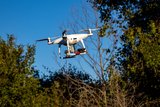
The Navy reached a milestone in its quest to gain energy independence today, when an MQ-8B Fire Scout successfully flew the first unmanned biofueled flight at Webster Field in St. Inigoes, Md.
The Unmanned Aircraft Systems Test Directorate piloted the helicopter fueled with a combination of JP-5 aviation fuel and plant-based camelina. The biofuel blend reduces carbon dioxide output by 75 percent when compared to conventional aviation fuel.
“Today’s flight marks a significant milestone with Fire Scout being the Navy’s first unmanned aircraft to use biofuel technology,” said Rear Adm. Bill Shannon, Program Executive Officer for Unmanned Aviation and Strike Weapons. “I am very pleased we can add MQ-8B to the list of successful bioflights completed at Pax River this year, bringing us one step closer to achieving the Navy’s energy goals.”
The MQ-8B Fire Scout Vertical Take-Off and Landing Tactical Unmanned Aerial Vehicle provides critical situational awareness, intelligence, surveillance, reconnaissance (ISR), and targeting data to the forward deployed warfighter. Fire Scout is designed to operate from all air capable ships and is currently providing ISR support during its first-land based deployment in U.S. Central Command area of responsibility.
Fire Scout is the seventh and final aircraft to demonstrate the versatility of biofuel through its use in all facets of naval aviation. The completion of aircraft biofuel testing at Pax River is another example of the Navy’s determination in achieving its goal of launching the “Great Green Fleet.”
Source: NAVAIR - Naval Air Systems Command




More from Uncrewed Vehicles
-
![The shift away from Chinese drone technology presents supplier opportunities]()
The shift away from Chinese drone technology presents supplier opportunities
As countries increasingly move away from Chinese drone manufacturing and focus on domestic production and collaboration, Europe and the US are well-placed to step in – although cost remains a crucial consideration.
-
![What’s next for the Pentagon after the Replicator programme?]()
What’s next for the Pentagon after the Replicator programme?
Although the Replicator initiative has made several accomplishments, there are still multiple gaps to plug across the US Department of Defense (DoD) and its services.
-
![Cummings Aerospace showcases Hellhound loitering munition designed for US Army’s LASSO programme (video)]()
Cummings Aerospace showcases Hellhound loitering munition designed for US Army’s LASSO programme (video)
Cummings Aerospace presented its turbojet-powered Hellhound loitering munition at SOF Week 2025, offering a man-portable solution aligned with the US Army’s LASSO requirements.
-
![SOF Week 2025: PDW unveils attritable FPV drone for SOF operations at scale]()
SOF Week 2025: PDW unveils attritable FPV drone for SOF operations at scale
PDW has revealed its Attritable Multirotor First Person View drone at SOF Week 2025, offering special operations forces a low-cost, rapidly deployable platform for strike and ISR missions, inspired by battlefield lessons from Ukraine.
-
![SOF Week 2025: Teledyne FLIR white paper provides guidance on reusable loitering munitions]()
SOF Week 2025: Teledyne FLIR white paper provides guidance on reusable loitering munitions
Teledyne FLIR is highlighting the emerging requirements for 'recoverable and re-usable' loitering munitions across the contemporary operating environment during this week’s SOF Week conference in Tampa, Florida.
-
![SOF Week 2025: Kraken Technology group debuts K3 Scout USV in North America]()
SOF Week 2025: Kraken Technology group debuts K3 Scout USV in North America
High-performance maritime industry player Kraken Technology Group, based in the UK, has used the SOF Week conference in Tampa, Florida this week to debut its K3 Scout uncrewed surface vessel (USV) to the North American market.