UK Royal Navy shifts focus from warships to system-led warfare
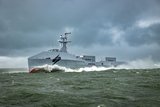
The new Type 26 City-class anti-submarine warfare frigates will operate with uncrewed and autonomous platforms, forming an integral part of the Hybrid Navy vision. (Photo: Crown Copyright/UK Ministry of Defence)
With a revised Defence Investment Plan on the way ahead of the upcoming NATO Summit on 7-8 July, the UK government has begun to reveal more details of how its future naval fleet could look.


The UK Ministry of Defence (MoD) has revealed plans to downsize its assault ship ambitions, stating that it will now procure “at least six” common combat vessels (CCVs) which will be the UK Royal Navy’s (RN) first “hybrid” warship.
In a move that had been foreshadowed by Shephard Defence Insight’s naval analyst Will Lupton upon the resignation of John Healey as defence secretary on 11 June, the UK’s planned Type 83 destroyers – intended as the successor to the Type 45 – appear to have been cancelled.
The number of new warships to be procured matches the number of Type 83s
Our news & analysis is now part of Defence Insight®
A Basic-level or higher Defence Insight subscription is now required to view this content.


More from Naval Warfare
-
![How France’s SNLE 3G programme is reshaping the naval nuclear industrial base]()
How France’s SNLE 3G programme is reshaping the naval nuclear industrial base
Extending far beyond a four-submarine replacement programme, France’s ballistic missile submarine effort is a decades-long industrial initiative designed to preserve the country’s ability to build and sustain nuclear-powered strategic platforms.
-
![China’s mineral processing dominance exposes naval supply chain vulnerabilities]()
China’s mineral processing dominance exposes naval supply chain vulnerabilities
Competition for critical minerals, and China’s dominance of their processing, is emerging as a decisive factor in future naval procurement programmes.
-
![Suppliers await next step in Australia’s mine warfare transition]()
Suppliers await next step in Australia’s mine warfare transition
Australia’s mine countermeasure capability remains in flux as the Huon-class nears retirement, but accelerated investment in autonomous systems is opening a path for industry.
-
![Can the US Navy ask Indo-Pacific allies to do more while training with them less?]()
Can the US Navy ask Indo-Pacific allies to do more while training with them less?
As the Iran War draws US ships and marine corps units away from the Indo-Pacific, curtailed exercises and a temporary carrier gap are exposing tensions between Washington’s demand for more self-reliant allies and the joint training needed to realise that ambition.