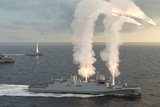
MBDA, Italian Navy detail development of Teseo Mk2/E missile
The Teseo Mk2/E will weigh 700kg and be shorter than its predecessor, with an estimated length between 4m and 5m. (Photo: author)
The new missile, which incorporates land-attack capabilities, is the latest evolution of the Otomat/Teseo anti-ship weapon family and is set to replace the legacy Mk2/A version in service with the Italian Navy.


A contract for developing the Teseo Mk2/E was signed in 2020 and became effective on 21 January 2021, with the service entry date scheduled for mid-2027.
MBDA says that the development of the missile is going ahead as planned, with the Preliminary Design Review completed in March 2023.
This phase is to be followed by the Detailed Design Review (DDR), which is already taking place, the Critical Design Review (CDR) and the Final Design Review (FDR).
Wind tunnel tests will commence in 2023, while the test firing campaign is planned to begin in 2024.
The latter is in five stages,
Our news & analysis is now part of Defence Insight®
A Basic-level or higher Defence Insight subscription is now required to view this content.


More from Naval Warfare
-
![How could Rheinmetall’s GMF 140 fit with ongoing programmes in North America?]()
How could Rheinmetall’s GMF 140 fit with ongoing programmes in North America?
With Canada committed to its River-class replacement and the USN pursuing a lower-cost frigate, Rheinmetall will need to demonstrate where the GMF 140 can fill a capability gap in the North American fleet.
-
![Australian industry programme builds pipeline for Virginia-class sustainment]()
Australian industry programme builds pipeline for Virginia-class sustainment
Australian businesses can now bid to support Virginia-class submarine sustainment in Western Australia, as momentum around the Henderson Defence Precinct also builds.
-
![South Korea, Japan and Turkey vie for US shipbuilding access in future frigate contest]()
South Korea, Japan and Turkey vie for US shipbuilding access in future frigate contest
Washington’s search for a foreign-built frigate could hand South Korea, Japan and Turkey a larger prize than a double-hull order: a foothold inside the US shipbuilding industrial base.
-
![Japan’s FY2027 budget bets on stand-off systems to offset demographic decline]()
Japan’s FY2027 budget bets on stand-off systems to offset demographic decline
Japan’s FY2027 defence budget backs stand-off strike, a 17-aircraft MQ-9B buy and a declared bid to lead the world in uncrewed maritime assets, alongside new frigates, submarines and support ships.