Royal Navy accepts OPV


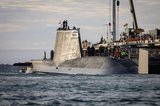
The Royal Navy has accepted the delivery of its newest Offshore Patrol Vessel (OPV), HMS Forth, from BAE Systems at the company’s Scotstoun shipyard.
Forth completed maiden sea trials in December and will now sail to Portsmouth where the vessel will be commissioned into Royal Navy service.
The new OPV fleet will carry out a range of roles for the navy, including counter-terrorism, anti-piracy and anti-smuggling. The rest of the fleet, HMS Medway, HMS Trent, HMS Tamar and HMS Spey, are all expected to enter service by 2020.
The 90m vessels will be equipped with a 30mm cannon and a flight deck capable of receiving a Merlin helicopter. Displacing around 2,000 tonnes, they will have a maximum speed of 24 knots and will be able to sail 5,500 nautical miles before having to resupply.
Defence Minister Guto Bebb said: ‘Thanks to the hard work of the Clyde shipyards, HMS Forth is now ready to join the Royal Navy surface fleet and begin the vital task of defending the UK and her interests around the world.’


More from Naval Warfare
-
![Five years on: where could opportunities emerge next for AUKUS Pillar II?]()
Five years on: where could opportunities emerge next for AUKUS Pillar II?
Payload commonality, combat systems and electronic warfare are emerging as likely priorities as the trilateral partnership balances building submarines with sharing industrial ecosystems.
-
![From the Baltic to the Gulf: where USV procurement is heading next]()
From the Baltic to the Gulf: where USV procurement is heading next
Saildrone’s new Copenhagen base is one sign of a larger shift, as navies globally turn to uncrewed vessels for surveillance and mine clearance.
-
![Quantum sensing gathers pace as navies eye undersea advantage]()
Quantum sensing gathers pace as navies eye undersea advantage
As AI dominates defence conversations, industry increasingly points to quantum sensing as the technology set to change submarine and uncrewed underwater vehicle operations.