Light Reconnaissance Strike – enabling a vital mission set (Studio)
A new system-of-systems concept will unlock digital integration of sensors and weapons for Light Forces, allowing them to shape the battlefield environment on their own terms and upgrade legacy platforms.


Brought to you in partnership with ST Engineering
At this September’s DSEI event in London, ST Engineering unveiled its Light Reconnaissance Strike (LRS) concept, designed to provide Light Forces with improved levels of mobility, precision strike and survivability.
Developed with input from the Group’s growing customer base in Europe, North America and Asia-Pacific and informed by observations from the ongoing war in Ukraine, LRS takes a system-of-systems approach, enabled by an open, modular and scalable digital backbone provided by Ultra’s Electronic Architecture Kit (EAK).
Light Forces will be able to quickly plug and play a wide range of capabilities including direct/indirect fires, uncrewed aerial and ground vehicles, counter-drone systems, fire control and communications, to create a secure and self-contained sensor-to-shooter ecosystem. This is enabled by ST Engineering’s digital connectivity, which provides integration in an OEM-agnostic manner.
LRS will allow mature armed forces to cost-effectively upgrade legacy analogue platforms into “digital-enabled assets” to support urgent modernisation requirements.
Rolling out rapid upgrades
What has given rise to this development? According to the Head of International Business and Market Development for Defence and Public Security at ST Engineering and former Chief Infantry Officer of the Singapore Army, BG (Ret) Chua Jin Kiat, modern warfare continues to evolve at pace with armed forces now constantly reviewing their concepts of operations (CONOPS), incorporating lessons learnt from today’s battles in order to be ready for tomorrow’s conflicts.
“The LRS concept is designed to provide rapidly realisable capability upgrades for forces to meet today’s operational challenges with greater mobility and lethality. By upgrading existing equipment through digitalisation, armed forces can achieve force-multiplier outcomes through a quick modernisation cycle,” he said.
At DSEI, Ultra’s EAK was showcased on board a variety of tactical ground vehicles including the Armormax Tac6 6x6 (shown at ST Engineering’s booth), GM Defense LTV-C, MSI-Defence Systems/Supacat HMT, General Dynamics UK/Ford Ranger Super Duty or Infantry Squad Vehicle, Supacat Jackal 3 and Babcock General Logistics Vehicle.
The technology also enabled a Babcock-led demonstration which networked ST Engineering’s 120mm Ground Deployed Advanced Mortar System (GDAMS) fire control system to the British Army’s Bowman ComBAT Infrastructure and Platform (BCIP) Battlefield Information System Application – a “first-of-its-kind networked firepower from sensor to effector”, which can be implemented across the UK MoD’s Digital Targeting Web, according to Babcock.
“There is no doubt in my mind that any army practitioner who saw the demo would have easily understood the application of technology and how it could easily enhance their capabilities,” Chua said.
Filling the firepower gap
There is clear potential in such an approach – according to Shephard Group’s Land Analyst, Dr Peter Magill, Light Forces have traditionally been forced to work within battlefield conditions dictated by heavier, armoured units or air power. But he suggested concepts like the LRS will enable those Light Forces to shape the battlefield themselves for the first time.
“Being light, they can’t traditionally carry a lot of heavy, organic firepower with them, but with some of the new technologies we’re seeing emerge, that’s maybe a gap that can now be filled with this kind of concept.
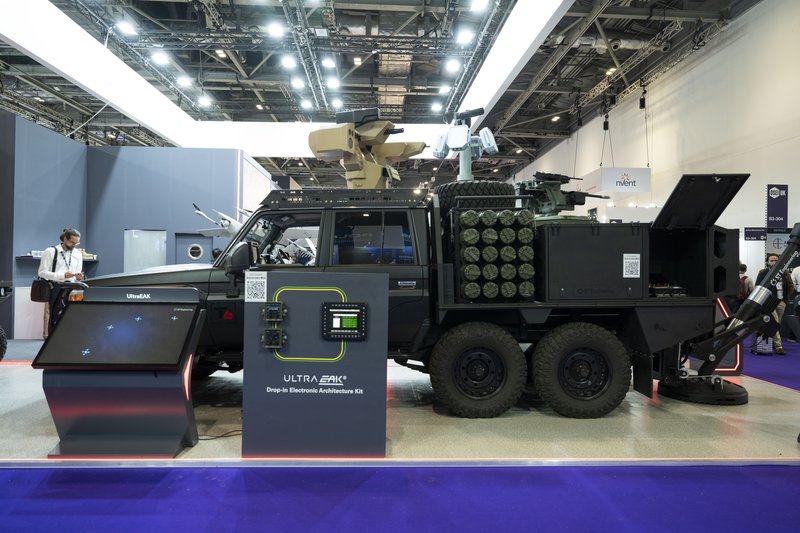
“You could have a light unit that gets close to the enemy without being detected but which can then quickly deploy mortars or one-way effectors to neutralise hostile positions while the remainder of the wider force joins the battle. That sounds like a very useful capability, but it needs to be enabled properly to ensure it works,” he warned.
“I think we’re already seeing a lot of integration of new technologies and that’s going to significantly increase with the evolution of uncrewed aerial vehicles and that kind of thing. We’ve seen in Ukraine that Light Forces need to be able to speak to each other and the Ukrainians have done a great job showing how different systems from different companies can communicate with one other which makes things so much easier on the battlefield.”
Defending against drones
Also learning from the ongoing war in Ukraine, ST Engineering believes LRS can also optimise the integration and mission success of counter-drone systems across lighter vehicle fleets.
“You just have to see what the Ukrainians are doing to the Russians in terms of deploying very cheap drones with kinetic payloads, and also developing equally affordable counter-drone capabilities,” Chua said.
“We see OEMs introducing a lot of counter-drone systems and moving towards platform-centric protection. Sensors and effectors can be integrated on board a ground vehicle, allowing them to benefit from improved levels in detection and identification of threats, and capacity to neutralise with a variety of soft- and hard-kill effects. This space is growing very quickly so Light Forces require the means to quickly upgrade and bolt on counter-drone capabilities at pace,” he explained.
LRS is also well suited to supporting more immediate, selective upgrades to tactical ground vehicles, according to the Group.
“Even if a Light Force does not want to digitise an entire fleet, they can upgrade vehicles with certain configurations, depending on their conops, and deploy them quickly and cheaply,” Chua suggested.
“This area isn’t where the big investment lies, unlike the procurement of armoured fighting vehicles and main battle tanks. But I believe this is something that we can offer, not just as a product but as a partner to design the capability together and deliver a concept which can enhance capabilities overnight. It is a simple and affordable proposition,” he added.
“We are ready to integrate everyone’s capabilities into our own platforms and vice versa. A lot of thinking goes into the way our systems are designed for inexperienced, conscript soldiers so solutions must be easy to train and easy to use,” Chua said, acknowledging an increasingly educated and digital-savvy population in Singapore, which naturally translates into an increasingly tech-savvy armed forces.
“Soldiers of today use smartphone apps in their everyday lives. Defence solutions need to be as good as these apps, with equally fast connectivity, and this is the basis of what we aspire to when it comes to the design and development of our products,” he stressed.
Solving tomorrow’s problems today
Magill meanwhile underlined the importance of affordability and the ability for customers to purchase enough capability to have a “major impact” at the tactical edge.
“Mobile mortars on the back of a truck are an example. We need more of them, but we need to make sure they’re not prohibitively expensive,” he warned, going on to highlight the importance of software-defined systems to keep pace with rapidly emerging threats.
“In Ukraine, there’s about a three-week life cycle in the development of drones. So, in about that time, something new will come along and it’s important that technology stays up to date, because we don’t want to have the perennial problem of always being ready to fight the previous war.
“We need to make sure that industry stays on top of things and is offering capabilities which will meet not just the problems of yesterday and today, but potentially what’s going to be the problem of tomorrow.”
And as Magill concluded, Light Forces should not be replacing heavier units but augmenting them: “They’re very much going to be complementary.”




More from Studio
-
![Energy evolution: How laser defence systems are powering the next phase of air defence (podcast)]()
Energy evolution: How laser defence systems are powering the next phase of air defence (podcast)
Laser-based air defence is moving from promise to deployment as global threats evolve. In this special podcast, we explore how high-energy laser systems are reshaping interception strategies.
-
![Unlocking the potential of Light Forces in modern warfare (Studio)]()
Unlocking the potential of Light Forces in modern warfare (Studio)
The Ukraine conflict has highlighted the strategic importance of “Light Forces” – rapidly deployable dispersed units, able to conduct an expanding range of mission sets. What technologies and equipment are needed to ensure their success in combat?
-
![Resilience, adaptiveness and collaboration vital for success in space (Studio)]()
Resilience, adaptiveness and collaboration vital for success in space (Studio)
Speakers at the Defence In Space Conference (DISC) 2025 highlighted the critical and evolving role of space in national security, defence and the global economy.
-
![Precision on Demand: The New Age of Loitering Weapons (Podcast)]()
Precision on Demand: The New Age of Loitering Weapons (Podcast)
Loitering munitions provide vital capabilities in the disrupted and unpredictable modern battlespace, from real-time ISR to a virtually “on demand” strike capability. Rafael is looking to the future of the technology, empowering systems to operate with increasing autonomy in hostile environments.
-
![Beyond Survivability: How Active Protection Systems Are Empowering Commanders (Podcast)]()
Beyond Survivability: How Active Protection Systems Are Empowering Commanders (Podcast)
As threats diversify and intensify, APS are proving essential not just for vehicle protection but also for enhancing operational freedom, effectiveness and mission success in contested environments.
-
![Combat-proven capabilities: How precision-strike systems are evolving for tomorrow’s battlespace (podcast)]()
Combat-proven capabilities: How precision-strike systems are evolving for tomorrow’s battlespace (podcast)
Combat-tested technology is being reshaped to counter A2/AD threats, reduce reliance on GPS and enable faster, more autonomous targeting in complex environments. In this special podcast, experts explain how the evolving threat landscape is shaping next-generation strike capabilities.