Austal delivers RNOV Al Mubshir


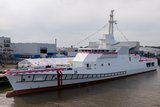
Austal has delivered the RNOV Al Mubshir High Speed Support Vessel (HSSV) to the Royal Navy of Oman (RNO), it announced on 20 May.
This is the first of two 72-metre HSSVs to be delivered to the RNO as part of a $124.9 million contract that includes the design and construction of the vessels and integrated logistics support.
Austal began construction of the HSSVs in August 2014 in its shipyard in Henderson, Western Australia. The second HSSV is due to be delivered later in 2016.
The HSSV offers various capabilities for naval operations, including search and rescue operations, rapid cargo and personnel deployment, and helicopter operations. They are to be deployed in missions similar to the US Navy’s Expeditionary Fast Transport (EPF) programme. The EPF is also manufactured by Austal at is Mobile, Alabama shipyard.
David Singleton, CEO of Austal, said: ‘Construction of the second HSSV is progressing well and on track for delivery to the Royal Navy of Oman later this year.
‘Meanwhile, the Henderson shipyard is also busy with construction of two further Cape Class Patrol Vessels valued at $63 million, which will be deployed by the Royal Australian Navy, as well as design work for the recently awarded $305 million Pacific Patrol Boats Replacement Project.’


More from Naval Warfare
-
![AUKUS heavyweight torpedo test raises questions over future armed UUV requirements]()
AUKUS heavyweight torpedo test raises questions over future armed UUV requirements
A heavyweight torpedo firing from the Royal Navy’s uncrewed submarine XV Excalibur suggests a shift beyond surveillance, with allied navies eyeing strike roles for large autonomous undersea vessels.
-
![Industrial teams prepare roadmap for Indonesia aircraft carrier transformation]()
Industrial teams prepare roadmap for Indonesia aircraft carrier transformation
Fincantieri and PT PAL have agreed on a framework to modernise the former Giuseppe Garibaldi, with drones, communications and broader Italian–Indonesian industrial ties involved.
-
![Five years on: where could opportunities emerge next for AUKUS Pillar II?]()
Five years on: where could opportunities emerge next for AUKUS Pillar II?
Payload commonality, combat systems and electronic warfare are emerging as likely priorities as the trilateral partnership balances building submarines with sharing industrial ecosystems.